

Building Smarter Robots: The Next Big PhD Research Opportunity
Kenfra Research - Bavithra2026-01-16T17:01:27+05:30Building Smarter Robots is quickly becoming one of the most exciting and impactful research areas for PhD scholars across engineering, computer science, and artificial intelligence. Robots are no longer limited to factories or simple repetitive tasks. Today, smarter robots can learn, adapt, make decisions, and interact with humans in meaningful ways. This rapid growth has opened up huge opportunities for doctoral research, innovation, and real-world impact.
If you are planning a PhD or already working on one, understanding how and why Building Smarter Robots is the next big research opportunity can help you choose a future-proof topic with strong academic and industry demand.
What Does Building Smarter Robots Mean?
Building Smarter Robots refers to designing robots that can think, learn, and act intelligently instead of just following fixed instructions. These robots use advanced technologies like:
- Artificial Intelligence (AI)
- Machine Learning (ML)
- Computer Vision
- Natural Language Processing (NLP)
- Sensor Fusion
- Autonomous Decision-Making
Unlike traditional robots, smarter robots can adapt to new environments, learn from experience, and work safely alongside humans.
Key PhD Research Areas in Building Smarter Robots
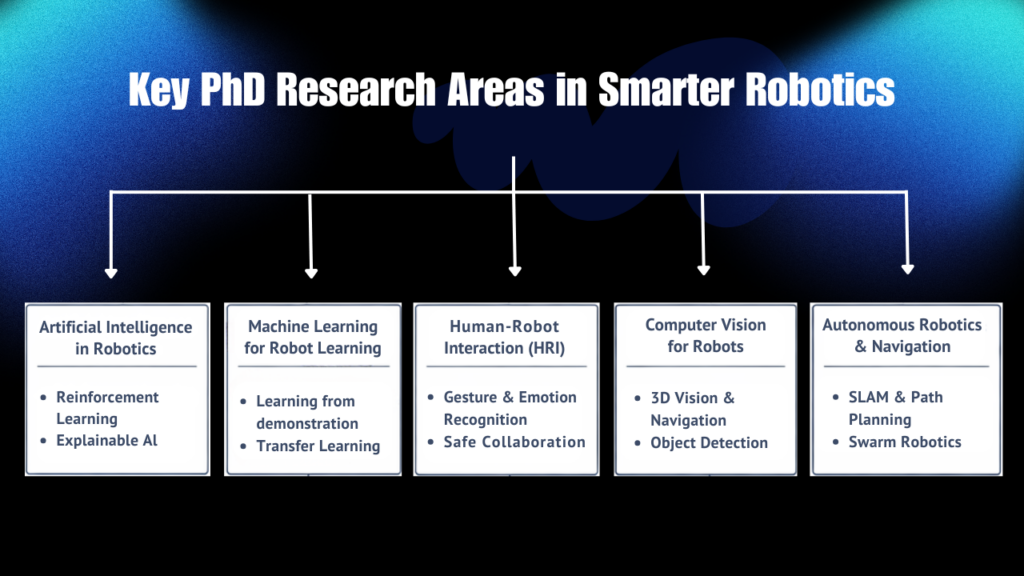
1. Artificial Intelligence in Robotics
Artificial Intelligence plays a central role in Building Smarter Robots because it allows machines to think, decide, and act intelligently. In this PhD research area, scholars focus on developing decision-making algorithms that help robots choose the best action in different situations. Reinforcement learning is widely studied, as it enables robots to learn through trial and error in dynamic environments. Deep learning techniques are also used for robotic control, helping robots handle complex tasks such as manipulation and navigation. Another important direction is explainable AI in robotics, which ensures that robotic decisions are transparent and understandable. Due to its wide applications and strong impact, AI-based robotics research remains one of the most cited and well-funded areas in academia and industry.
2. Machine Learning for Robot Learning
Machine learning is essential for Building Smarter Robots that can adapt and improve over time. This research area focuses on enabling robots to learn from data, experience, and interaction with the environment. Learning from demonstration allows robots to observe human actions and replicate them efficiently. Self-learning robots can adjust their behavior without constant human guidance, making them more autonomous. Transfer learning in robotics helps robots apply knowledge gained in one task or environment to another, reducing training time. Data-efficient learning methods are also important, as real-world robotic data is often expensive and time-consuming to collect. Together, these approaches help robots operate reliably in real-world conditions.
3. Human-Robot Interaction (HRI)
Human-Robot Interaction is a critical research area in Building Smarter Robots that can work safely and naturally with people. PhD research in this field focuses on improving how robots understand human behavior through gesture and speech recognition. Emotion-aware robots are designed to detect and respond to human emotions, making interactions more natural and effective. Another key area is safe collaboration, where robots are developed to work alongside humans without causing harm. Social robotics also plays an important role, especially in environments like hospitals, schools, and homes. HRI research is particularly valuable for healthcare robots, service robots, and educational applications.
4. Computer Vision for Smarter Robots
Computer vision gives robots the ability to see and understand their surroundings, making it a core component of Building Smarter Robots. PhD research in this area focuses on object detection and recognition, which allows robots to identify and interact with items in their environment. 3D vision and depth perception help robots understand spatial relationships and distances. Visual navigation enables robots to move safely and efficiently by analyzing visual data. Scene understanding goes a step further by helping robots interpret complex environments. Computer vision is essential for autonomous robots and plays a major role in improving accuracy, safety, and efficiency in robotic systems.
5. Autonomous Robotics and Navigation
Autonomous robotics is a fundamental pillar of Building Smarter Robots, as it enables robots to operate without continuous human control. PhD research in this area includes developing efficient path planning algorithms that help robots move from one point to another while avoiding obstacles. Simultaneous Localization and Mapping (SLAM) allows robots to build maps of unknown environments while tracking their own position. Multi-robot coordination focuses on enabling multiple robots to work together effectively. Swarm robotics studies how simple robots can collectively perform complex tasks. Autonomy is essential for applications such as self-driving vehicles, drones, and exploration robots.
How to Choose a Good PhD Topic in Smarter Robotics?
When selecting your PhD topic in Building Smarter Robots, consider:
- Current research gaps
- Availability of datasets or hardware
- Supervisor expertise
- Industry relevance
- Long-term career goals
A well-defined problem with real-world application always leads to better research outcomes.
FAQs on Building Smarter Robots
1. Why is building smarter robots a good PhD research topic?
Building smarter robots is a good PhD topic because it has a strong future. It combines AI, machine learning, and robotics. Many industries need smart robots, so research in this area gets good funding, more publications, and better job opportunities after completing a PhD.
2. What background is needed to do a PhD in building smarter robots?
Students from computer science, electronics, mechanical engineering, or artificial intelligence can work on building smarter robots. Basic knowledge of programming and mathematics is enough to start. Most robotics and AI skills are learned step by step during the PhD research period.
3. What problems do researchers face in building smarter robots?
Building smarter robots is challenging because robots must work in real-world conditions. Researchers face issues like high computing needs, lack of data, hardware limitations, and safety concerns. Solving these problems makes the research more valuable and useful for real-life applications.
4. What jobs are available after a PhD in building smarter robots?
After a PhD in building smarter robots, students can work as robotics engineers, AI researchers, professors, or scientists. Jobs are available in universities, research labs, startups, hospitals, and technology companies working on automation and intelligent systems.
5. How can PhD students get help for research in building smarter robots?
PhD students working on building smarter robots can get help with topic selection, proposal writing, research work, coding, paper publication, and thesis writing. Proper guidance helps reduce stress, avoid mistakes, and complete the PhD successfully on time.
Conclusion
Building Smarter Robots is more than just a research trend—it is shaping the future of technology and society. For PhD scholars, this field offers innovation, impact, funding, and long-term career growth. With applications across healthcare, industry, agriculture, and space, smarter robotics research opens doors to both academic excellence and real-world solutions.
If you are planning or struggling with your PhD journey, kenfra research will do all kinds of PhD support including topic selection, proposal writing, research guidance, implementation help, paper publication, and thesis assistance.










Leave a Reply