

Confused About PhD Topic Selection in CSE? Read This Before You Decide
Kenfra Research - Bavithra2026-01-15T17:17:47+05:30Choosing the right PhD topic selection in CSE (Computer Science and Engineering) is one of the toughest and most important decisions in your academic journey. Many students start with excitement but soon get confused, overwhelmed, or stuck. The topic you choose can shape your research experience, publications, career path, and future opportunities. If you are asking how to choose a PhD topic in computer science, this guide will walk you through every major step in a simple, clear, and actionable way. Let’s get started!
Why PhD Topic Selection in CSE Matters So Much?
Choosing the right PhD topic in CSE is far more than just picking a title—it shapes your entire research journey. Your topic determines what you will study for the next 3 to 5+ years, the research problems you will tackle, and the skills, tools, and methodologies you will develop along the way. It also influences the publications you produce and the overall direction of your career, whether that’s in academia, industry, startups, or specialized AI labs. Selecting a topic without careful consideration can lead to frustration, wasted time, and research with little impact. On the other hand, a well-chosen topic provides clarity, motivation, and a meaningful path, enabling you to contribute valuable knowledge to your field and achieve long-term success.
Step by Step Guide to PhD Topic Selection in CSE
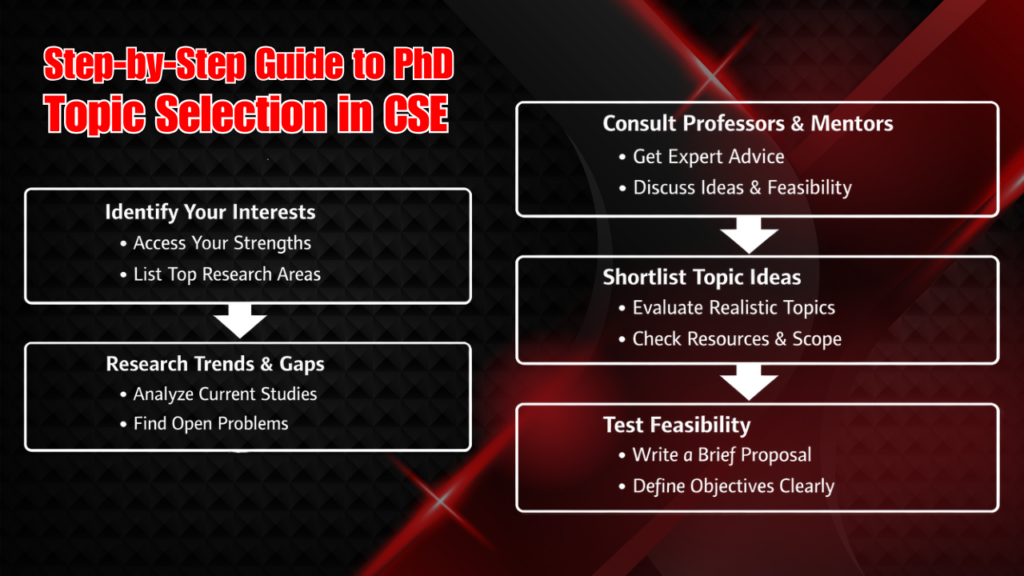
1. Identify Your Interests
The first step in PhD topic selection in CSE is understanding your own interests and strengths. Reflect on your past experiences and ask yourself questions like: Which subjects excited me the most during my Master’s? Which classes or projects did I truly enjoy? Do I prefer theoretical areas such as algorithms, systems, or security, or am I more drawn to applied fields like AI, computer vision, or networks? Additionally, consider whether you want your research to have a strong industry focus or make a deeper academic impact. By honestly answering these questions, you can narrow down your focus and create a list of your top 3–5 research interests, which will serve as the foundation for exploring potential PhD topics.
2. Research the Field: Trends & Gaps
The next step in PhD topic selection in CSE is to understand where the field is heading and identify current research opportunities. Start by exploring top conferences such as NeurIPS, ICML, SIGCOMM, and reviewing publications from IEEE and ACM. Look at recent journals and articles to spot emerging trends, analyze citation patterns, and identify technologies gaining momentum, such as AI, quantum computing, blockchain, IoT, and cybersecurity. Reading survey papers can give you a clear picture of what problems have already been solved and which challenges still remain. This research is crucial for how to choose a PhD topic in computer science that is not only relevant today but also has the potential to make a meaningful impact in the future.
3. Talk to Professors and Mentors
In PhD topic selection in CSE, your supervisor and mentors are just as important as the topic itself. Arrange meetings with professors whose work you admire, professionals working in your area of interest, and senior PhD students or alumni. During these discussions, ask questions like: What research problems still need attention? What tools, techniques, or skills are essential for this work? Which areas have the highest potential for impact? Their insights and experience can provide invaluable guidance, helping you refine your ideas and choose a topic that is both feasible and significant in the field.
4. Shortlist Realistic Topic Ideas
After combining your interests, field research, and mentor guidance, it’s time to create a list of realistic topic possibilities. Evaluate each idea by asking questions such as: Is this topic researchable? Can I access enough literature to support my work? Do I have the necessary resources, like software, datasets, or hardware? And is guidance available if I encounter challenges? Focus on shortlisting a few specific research topics rather than broad areas. For example, a vague topic like “Machine Learning” is too general, whereas a more precise and feasible topic would be “Efficient Federated Learning Algorithms for Resource-Constrained Devices.” Specific topics make your research manageable, clear, and impactful.
5. Test Topic Feasibility
Before finalizing your PhD topic selection in CSE, it’s important to evaluate whether your chosen idea is practical and well-defined. Ask yourself: Can I clearly define a research problem? Are there measurable objectives I can aim for? Is the scope manageable—not too broad or too narrow? Do I have access to necessary datasets or simulation environments? To clarify your thoughts, try writing a short proposal of about 500–1000 words that outlines the motivation for your research, the gap you intend to address, your proposed solution, and the expected outcomes. If you can articulate these points clearly, it’s a strong indicator that your topic is well-conceived and ready to move forward.
How to Judge a Good vs Bad Topic?
Good Topic Traits
- Clearly defined problem
- Relevant to current technology and research
- Feasible with available tools
- Can produce at least one quality publication
- Matches your long‑term goals
Bad Topic Traits
- Too broad or vague
- Super niche with no research impact
- Requires unavailable resources
- No clear research gap
Top PhD Research Topic Ideas CSE (2026 & Beyond)
Here’s a list of promising CSE thesis topic selection areas you can explore:
Artificial Intelligence & Machine Learning
- Explainable AI for real‑world decision systems
- Fairness and bias mitigation in deep learning
- Low‑power AI for edge devices
Cyber Security
- Post‑quantum cryptography
- Secure and private multi‑party computation
- AI‑driven intrusion detection
Data Science & Big Data
- Scalable real‑time analytics
- Distributed database optimization
- Graph neural networks for social data
Computer Networks
- 6G network design and optimization
- Edge computing for ultra‑low latency
- Network resilience and fault tolerance
Cloud & Distributed Systems
- Serverless computing performance
- Resource allocation in hybrid clouds
- Container security
Human‑Computer Interaction (HCI)
- Adaptive interfaces using AI
- Accessibility in emerging technologies
- VR/AR usability studies
These are just starting points, not final topics. You must shape them based on gaps and feasibility.
Common Mistakes to Avoid in PhD Topic Selection in CSE
Choosing Based on Trends Alone
Trending topics may seem exciting, but they are not always research-worthy. Don’t pick a topic just because it’s “hot.” Trends can fade quickly, and what’s popular today might be saturated with research, leaving little room for novelty. Focus instead on areas where you can make a genuine contribution and sustain long-term interest.
Copying Someone Else’s Work
Avoid repeating existing research with minimal innovation. Your topic must have a clear research gap. Simply replicating someone else’s work can lead to low-impact results and difficulty publishing. Aim to build upon existing knowledge while introducing original ideas or approaches that advance the field.
Ignoring Advisor Compatibility
Even a great topic can fail without the right mentorship. An advisor’s guidance, feedback, and support are critical to navigating challenges in your research. Misalignment in research interests or supervision style can cause delays and frustration, so choose a mentor whose expertise and approach match your goals.
Making Scope Too Large
PhD research is not about doing everything in the world. It’s about solving specific, meaningful problems. Trying to cover too much can lead to incomplete work, missed deadlines, and unnecessary stress. Focus on a well-defined problem with achievable milestones to maintain clarity and productivity throughout your PhD journey.
Tips for Staying Focused and Motivated
- Use research tools like Google Scholar, Semantic Scholar, ArXiv
- Track your literature with reference managers (Zotero, Mendeley)
- Set weekly research goals
- Join research groups and discussion forums
- Practice writing research summaries
Remember, topic selection is iterative — it evolves as you learn more.
FAQs (Frequently Asked Questions)
1. What is the best way for PhD topic selection in CSE?
Focus on your interest + research gaps + advisor guidance. Start broad, then narrow down to a feasible problem.
2. How do I find research gaps for my PhD topic?
Read recent papers, survey articles, and conference proceedings. See where authors mention “future work” or “limitations”.
3. How many topic ideas should I shortlist?
Aim for 3–5 solid ideas. Compare them based on interest, scope, novelty, and feasibility.
4. Can a topic change after starting PhD?
Yes — many students refine or pivot their topic during the first year based on findings and feasibility.
5. Should I pick a topic with industry relevance?
It depends on your goals. Industry relevance can increase career opportunities, but fundamental research topics also have value.

Conclusion
Choosing the right PhD topic selection in CSE is a journey — not a guess. Start with what you enjoy, explore current research, refine your ideas, and validate them with mentors and literature. Good topics are specific, impactful, and feasible. If you need support in PhD topic identification, proposal writing, literature review, or full research assistance, Kenfra Research will do all kinds of PhD support to help you succeed.









Leave a Reply