07Apr
When businesses grow, managing customers becomes more important than ever. Many companies get confused between crm or customer success software, thinking they are the same. But in reality, they serve different purposes.
Understanding crm or customer success software is important if you want to improve customer relationships and grow your business in the long term. In this blog, we will explain everything in simple words so you can clearly understand the differences and choose the right tool.
A CRM (Customer Relationship Management) system is a tool designed to manage interactions with leads and customers, primarily during the sales process.
Popular use cases of CRM include:
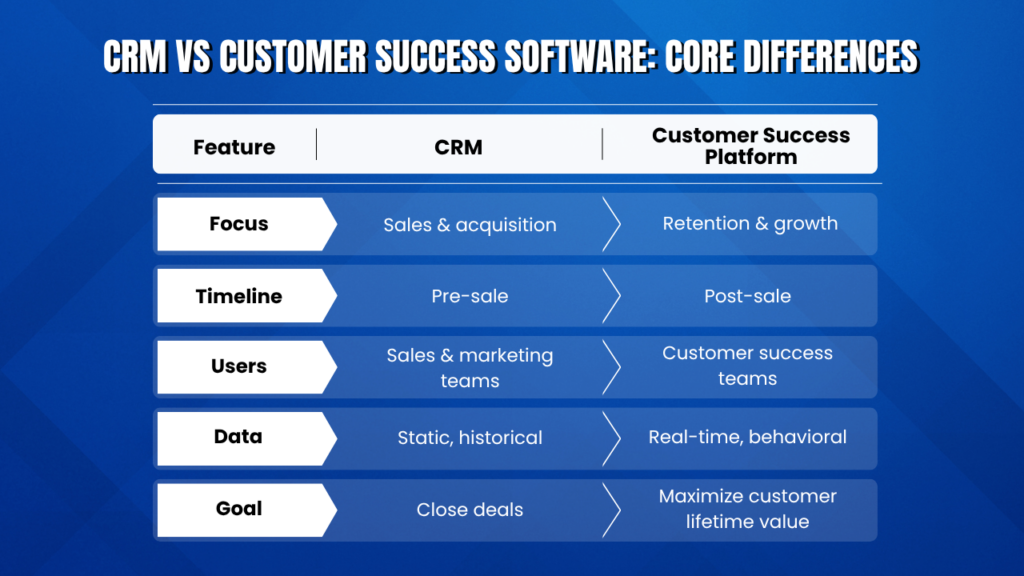
Businesses searching for a crm customer success solution often start with CRM tools, but traditional CRM platforms are built for acquisition—not retention.
A CRM helps companies:
However, when it comes to post-sale engagement, even the best client success CRM may fall short without dedicated success features.
A customer success platform is designed to help businesses ensure that customers achieve their desired outcomes after purchasing a product or service.
Unlike CRM systems, a customer success CRM focuses on long-term engagement, retention, and customer satisfaction.
A modern crm for customer success often integrates these capabilities, but standalone platforms are typically more powerful and specialized.
Many businesses initially rely on CRM systems and assume they can double as a customer success CRM. While this works in early stages, it quickly creates limitations.
Even a well-implemented crm for customer success may not provide the depth needed to reduce churn effectively.
Investing in a dedicated customer success platform unlocks several advantages and helps businesses build stronger, long-term relationships with their customers:
Customer Success tools help identify churn risks early, enabling proactive intervention. This means your team can fix issues before customers decide to leave, saving revenue and building trust.
With personalized onboarding and engagement, customers achieve value faster. When customers clearly understand your product and see results quickly, they are more likely to stay loyal.
A strong customer success CRM supports upselling and cross-selling opportunities. Happy customers are more open to upgrading plans or buying additional services.
Real-time insights allow teams to act on customer behavior, not just assumptions. This helps businesses make smarter decisions based on actual usage and feedback.
Automation ensures consistent experiences, even as your customer base grows. Your team can handle more customers without losing quality or missing important interactions.
Instead of choosing between CRM or customer success software, modern businesses combine both for maximum impact.
This combined approach creates a powerful crm customer success ecosystem.
If you’re evaluating a crm for customer success, look for these capabilities:
Many businesses today prefer hybrid solutions that function as both CRM and client success CRM, but depth still matters.
You should invest in both CRM and a customer success platform if:
In these cases, relying solely on a crm for customer success may limit your ability to scale effectively.
No, while SaaS companies commonly use it, any business that values long-term customer relationships can benefit from a client success CRM or customer success platform, including service-based and subscription businesses.
It depends on your goal. CRM is better for sales and lead management, while a customer success platform is better for retention and growth. Most businesses get the best results by using both together.
A customer success platform helps solve common problems like customer churn, low product adoption, poor onboarding, and lack of customer engagement. It gives your team clear insights to take action at the right time.
Use CRM for:
Use a customer success platform for:
The difference between CRM or customer success software is not just technical—it’s strategic.
While a customer success CRM or client success CRM may combine elements of both, the most successful businesses use dedicated tools that integrate seamlessly.
If your goal is sustainable growth, reduced churn, and stronger customer relationships, investing in both systems is not optional—it’s essential.
By adopting the right crm customer success strategy, you move beyond transactions and start building long-term value—exactly what modern customers expect.
Customers expect quick, personal, and helpful service. Businesses that fail to meet these expectations often lose customers to competitors. This... read more
In a digital-first business environment, customer relationships are the foundation of long-term success. Whether you run a startup, a growing... read more
Did you know that companies with disconnected systems waste about 30% of their work time on fixing data issues? This... read more
Running a business means managing customers, sales, follow-ups, and support every day. When customer data is stored in different spreadsheets,... read more
In today’s business world, everyone wants to work faster and more easily. Many companies still use spreadsheets, but they can... read more
Customer Relationship Management (CRM) systems are tools that help businesses manage their customers easily and keep everything organized. While most... read more
As businesses move into a more digital future, secure CRM software has become one of the most important tools for... read more
Many businesses invest in CRM software. But not everyone understands that there are different types of CRM tools. Some are... read more
Running a business means talking to customers, tracking sales, and managing a lot of information every day. A cloud-based CRM... read more
Cloud-Based CRM is changing the way modern businesses manage customers and daily operations. Instead of using complex software or storing... read more
WhatsApp us
Leave a Reply