

PhD Process in India Step-by-Step Guide: A Complete PhD Roadmap 2026
Kenfra Research - Bavithra2026-03-12T10:12:12+05:30Starting a PhD is a big academic decision. Many students feel excited, but also confused about the process. Questions like How do I register?, What happens after coursework?, and How long does a PhD take? are very common. This Complete PhD Roadmap 2026 explains every stage of a PhD journey clearly from registration to receiving your doctorate—in simple words that anyone can understand.
Whether you are a fresh postgraduate student or a working professional, this guide will help you plan your PhD step by step.
Why PhD Roadmap is Important?
A PhD is not just about research. It involves planning, documentation, reviews, writing, and final defense. Without a roadmap, students often face delays, stress, and confusion.
A Complete PhD Roadmap helps you clearly understand each stage of the doctoral process, from registration to submission. It ensures you stay organized, avoid unnecessary delays, and stay on track with deadlines. By following this roadmap, you’ll be better prepared for reviews, revisions, and the final submission, making it easier to complete your PhD on time.
The Complete PhD Roadmap 2026: A Step-by-Step Guide to Earning Your Doctorate
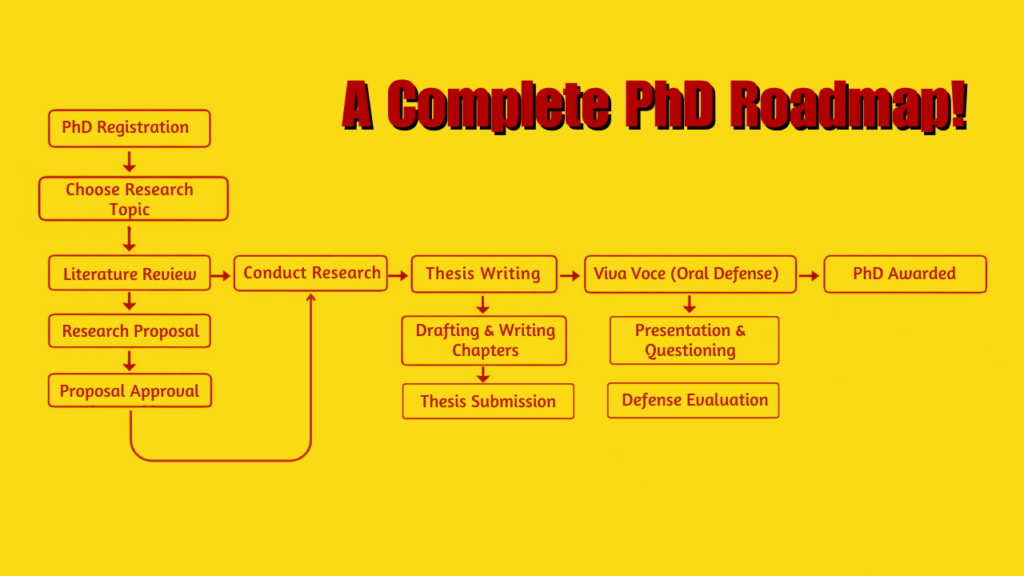
Phase 1: PhD Registration Process
The first official step in the PhD journey is registration, which involves several key stages. This begins with the submission of an application, followed by the approval of a research supervisor. Once a supervisor is assigned, the research topic is finalized in collaboration with them. After this, the student pays the registration fees to complete the process. In some universities, an entrance exam or interview may also be required before registration is officially confirmed.
Steps Involved:
- Application Submission: Fill out your university’s application form with personal, academic, and professional details. Include your research interests and prior publications, if any.
- Supervisor Approval: Universities assign or approve a research supervisor based on your proposed topic. A supervisor guides your research, reviews your work, and provides mentorship.
- Topic Finalization: Collaborate with your supervisor to refine your research idea. A clear topic ensures your research is focused and manageable.
- Payment of Registration Fees: Once approved, pay the required fees to officially start your PhD
Phase 2: Finalizing the Research Topic
After registration, students must finalize their PhD research topic, which is a crucial step in the process. The topic should also be feasible, with accessible data and resources. A thorough discussion with your supervisor is essential to refine and validate the idea. A well-defined research topic helps streamline the PhD journey, making the process more focused and manageable.
Considerations When Choosing a Topic:
- Alignment with your academic background.
- Relevance to current research trends.
- Presence of a research gap – something that hasn’t been studied extensively.
- Feasibility in terms of resources, time, and data access.
Steps to Finalize:
- Conduct preliminary literature reading to identify gaps.
- Discuss potential topics with your supervisor.
- Narrow down to a specific, focused, and achievable topic.
Phase 3: Coursework and Research Methodology
Most universities require PhD scholars to complete coursework during the initial phase of their program. To continue with the PhD, students must pass the coursework exams, which assess their understanding of these essential topics.
Common Coursework:
- Research Methodology: Quantitative, qualitative, and mixed methods.
- Research Ethics: Plagiarism, consent, data privacy.
- Subject-Specific Courses: Advanced topics in your field.
- Academic Writing & Communication: Effective thesis writing, publishing papers, and presentation skills.
Phase 4: Preparing and Submitting the Research Proposal
Once coursework is completed, scholars prepare a research proposal, which outlines the plan for their research project. The key parts of a research proposal include a clear problem statement, research objectives, a literature review, the proposed methodology, and the expected outcomes of the study. The proposal must be approved by the research committee before moving forward. This step is a crucial milestone in the PhD journey, as it sets the foundation for the entire research process.
Phase 5: Literature Review Phase
The literature review is the foundation of your research, where you thoroughly study journals, books, and research papers to understand the existing work in your field. During this phase, you identify research gaps that your work can address and justify how your research will contribute to advancing knowledge. A strong literature review not only improves the quality of your research but also plays a key role during thesis evaluation, demonstrating that your study is well-grounded in current academic discussions.
Phase 6: Research Work and Data Collection
This is the core stage of your PhD. Research and data collection can come from multiple reliable sources:
1. Primary Sources:
Primary sources of data include methods that gather firsthand information directly from the source. These methods can involve surveys, questionnaires, interviews, and focus groups, which help collect personal opinions, experiences, and insights. They also include experiments and field observations, where researchers study phenomena or behaviors in controlled or real-world settings. Additionally, primary data can come from direct interactions with customers, users, or participants, providing original information that is specific to the research study.
2. Secondary Sources:
Secondary sources of data consist of information that has already been collected, analyzed, and published by others. These include research journals, published papers, and books that provide established knowledge in a particular field. Other examples are conference proceedings, government reports, and company records, which offer documented insights and statistics. Additionally, case studies and white papers serve as secondary sources, presenting detailed analyses and expert perspectives that can support or inform your own research.
3. Digital & Online Sources:
Digital and online sources of data include information accessed through various internet-based platforms and tools. These sources encompass academic databases such as Google Scholar, IEEE, and Scopus, which provide scholarly articles and research publications. They also include websites, industry reports, analytics tools, and CRM systems that offer business and market insights.
4. Internal & Field Data:
Internal and field data consist of information collected from within an organization or directly from practical activities. This includes past project records and implementation data, which provide insights from previous work. It also encompasses pilot studies and market research reports that test ideas or analyze trends before full-scale implementation. Regular supervision meetings are essential to ensure your research stays on track.
Phase 7: Data Analysis and Interpretation
After collecting data, you need to analyze it properly. Common tools include:
- Quantitative tools: SPSS, R, Python, Excel.
- Qualitative tools: NVivo, ATLAS.ti.
Proper analysis ensures validity and reliability of your results, strengthening your thesis.
Phase 8: Pre-PhD Review and Progress Evaluation
Most universities conduct periodic research reviews to monitor the progress of your PhD work. The purpose of these reviews is to track your research progress, identify any issues early, and ensure the overall quality of your research. Passing these reviews is mandatory to move forward in the PhD journey, as they help keep your project on track and aligned with academic standards.
Phase 9: Thesis Writing Phase
Thesis writing is where all your work comes together, turning months or even years of research into a cohesive document. It’s a time to clearly communicate your findings, analysis, and the significance of your work. The final thesis serves as the culmination of your academic journey and a contribution to your field of study.
Main Chapters of a PhD Thesis:
- Introduction
- Literature review
- Methodology
- Results and discussion
- Conclusion and future scope
Simple Thesis Writing Tips:
- Follow university guidelines
- Write clearly and simply
- Avoid plagiarism
- Revise multiple times
Phase 10: Plagiarism Check and Thesis Submission
Before submission:
- Verify plagiarism percentage meets university standards.
- Obtain supervisor approval.
- Format the thesis according to guidelines.
Once completed, you can submit your thesis for evaluation.
Phase 11: Viva Voce (Thesis Defense)
The final academic step is the viva voce, where you present your research to a panel of examiners. During the viva, examiners will ask questions to assess your understanding and challenge your findings. You’ll need to justify your research, demonstrating a clear and deep understanding of your work. Proper preparation for the viva is essential for success in this critical stage of your PhD journey.
Phase 12: Award of Doctorate Degree
After a successful viva and any required corrections, the university will award you your PhD degree. Congratulations—you are now officially a Doctor! This marks the completion of your entire PhD journey, from registration to doctorate, a huge achievement that reflects years of hard work, dedication, and contribution to your field.
FAQs: Complete PhD Roadmap
- How long does it take to complete a PhD?
A PhD usually takes between 3 to 6 years, depending on the university and discipline. Some students may take longer if their research is particularly complex or if they pursue part-time study.
- Is coursework compulsory in a PhD?
Yes, most PhD programs require coursework in the initial phase to build foundational knowledge. However, some programs offer a more flexible structure that might involve fewer or more specialized courses depending on your field.
- Can I do a PhD while working?
Yes, many universities offer part-time or flexible PhD programs for working professionals. Balancing work and PhD research can be challenging, but with time management and a strong support system, it’s definitely doable.
- What is the most difficult stage of a PhD?
Many students find thesis writing and data analysis to be the most challenging parts of their PhD. This is because it requires synthesizing years of research into a coherent argument and dealing with complex data that may not always follow the expected trends.

Conclusion: Follow the Right PhD Roadmap for Success
A PhD is a long journey, but with the right planning and guidance, it becomes manageable and rewarding. This complete PhD roadmap 2026 clearly shows every stage—from registration to doctorate—so you can move forward with confidence.
At kenfra research, we provide all kinds of PhD support including topic selection, proposal writing, data analysis, thesis writing, plagiarism reduction, and end-to-end doctoral guidance to help scholars successfully complete their PhD.







Leave a Reply