journal indexing

From Scopus to Web of Science: Cracking the Journal Indexing Code

When you begin your research or PhD journey, one term you will hear everywhere is Journal Indexing. Whether your target is Scopus or Web of Science, understanding how journal indexing works will help you submit your manuscript with confidence. Indexed journals are trusted, more visible, and widely recognized by universities across the world. With the right knowledge, you can avoid predatory journals and choose the best publication path.

What Is Journal Indexing and Why It Matters?

A Journal Indexing means a journal listed in a respected academic database. When a journal is indexed, it becomes easier for researchers worldwide to discover, read, and cite the work published in it. This directly improves the credibility of your paper and strengthens your academic profile.

Indexing matters because it increases your research visibility, makes your publications more valuable for promotions and evaluations, and protects your work by keeping it in a trusted academic environment. This is why most universities demand publications in Scopus indexing or Web of Science indexing journals.

Scopus vs Web of Science: A Simple Understanding

One of the largest and most widely used citation databases, Scopus covers engineering, science, social science, business, management, and many more fields. Researchers appreciate Scopus for its broader coverage, citation tracking, author profiles, and simple metrics. In contrast, Web of Science is more selective and includes premium indexing categories like SCI, SSCI, AHCI, and ESCI. Journals in Web of Science go through a strict evaluation process. As a result, many organizations consider it the gold standard in academic publication.

Both platforms are respected; however, the main difference is that Scopus is broader, whereas Web of Science is more exclusive. Therefore, your choice of platform depends on your specific needs and goals in academic publishing.

How to Check If a Journal Is Really Indexed?

Today, many fake and predatory journals falsely claim indexing. To stay safe, always check the indexing status yourself.

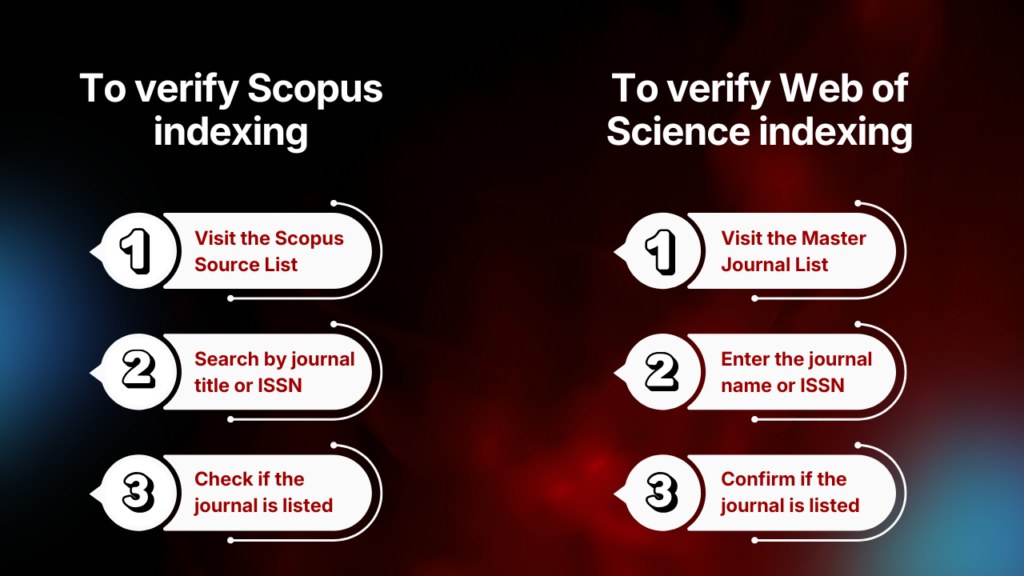
Verify Scopus indexing:

  • Visit the official Scopus Sources website
  • Search the journal name or ISSN

To verify Web of Science indexing:

  • Visit the Master Journal List
  • Enter the journal name or ISSN
  • Confirm if it appears in SCI, SSCI, AHCI, or ESCI

Never trust indexing claims mentioned only on a journal’s homepage.

How to Choose the Right Indexed Journal?

Choosing the right journal greatly affects your chances of acceptance. First, identify your research field clearly and select journals that publish related work. Additionally, make sure the journal’s aims and scope match the content of your manuscript. Always confirm whether the journal is listed under Scopus indexing or Web of Science indexing based on your requirement.

Moreover, reading a few previously published papers helps you understand the journal’s writing style and expectations. Furthermore, check the submission guidelines carefully to avoid mistakes. Lastly, journals that promise extremely fast acceptance should be avoided.

Common Challenges Researchers Face

Many researchers struggle with identifying genuine indexed journals, preparing manuscripts according to the guidelines, or structuring content properly. Issues like unclear abstracts, weak methodology, outdated references, and formatting errors often cause rejections. Lack of guidance also leads to choosing predatory or low-quality journals.

How to Get Your Journal Indexed in Scopus or Web of Science?

1. Ensure Quality and Relevance

Both Scopus and Web of Science look for journals that provide high-quality research in a specific field. Ensure that your journal maintains high editorial standards, includes peer-reviewed articles, and focuses on a particular area of academic research.

2. Submit to Database Review

Journals must go through a formal review process to get indexed in Scopus or Web of Science. Submit your journal’s application to the respective database, ensuring that it meets the required editorial and publishing standards.

3. Citation Performance

While Web of Science does not require an existing Impact Factor, it does consider citation patterns and academic influence. And Scopus also values citation performance, though it is generally more flexible.

4. Consistency in Publishing

A journal must maintain a regular publishing schedule, whether it’s quarterly, monthly, or annual. Both databases prioritize consistency in the publishing process, as it indicates reliability and professional management.

5. International Reach and Diverse Authors

The Journals indexed in Scopus or Web of Science tend to have international contributors and readership. This ensures a global audience for the research articles published in the journal, increasing its impact and relevance.

Common FAQs on Journal Indexing:

1. How long does it take for a journal to be indexed in Scopus or Web of Science?
The indexing process typically takes several months. It involves a detailed review of the journal’s content, editorial board, and publishing standards.

2. Can a journal be indexed in both Scopus and Web of Science?
Yes, a journal can be indexed in both Scopus and Web of Science, though each database has its own selection criteria.

3. Does being indexed in Scopus or Web of Science guarantee higher citations?
Being indexed in Scopus or Web of Science can increase visibility, which may lead to more citations, but actual citation counts depend on the quality and relevance of the research.

4. How do I know if a journal is indexed in Scopus or Web of Science?
You can check the database’s official websites for the list of indexed journals. Both Scopus and Web of Science provide searchable lists to help you verify if a journal is indexed.

Shaping Your Research Career

Understanding journal indexing gives you a clear advantage in your research publication journey. Whether you aim for Scopus indexing or Web of Science indexing, choosing the right journal, preparing your manuscript carefully, and avoiding predatory publishers can make the entire process smoother.

At Kenfra Research, we provide comprehensive PhD support for researchers looking to publish in high-impact journals and get indexed in Scopus or Web of Science. From choosing the right journal to optimizing your submission, we are here to guide you every step of the way.

Share this post

Leave a Reply

Your email address will not be published. Required fields are marked *