

How Can You Publish an IEEE Paper Faster in 2026? A Practical Guide for Researchers
Kenfra Research - Bavithra2026-01-23T16:32:51+05:30In 2026, many researchers are looking for smart ways to publish an IEEE paper faster without compromising quality or ethics. With increasing competition, stricter review standards, and limited academic timelines, publishing quickly has become just as important as publishing correctly. The good news is that IEEE publication delays are often caused by avoidable mistakes—and with the right approach, you can significantly reduce the waiting time. This blog explains practical, time-saving strategies that engineering scholars, PhD researchers, and academicians can use to speed up IEEE paper publication in 2026.
Why Publishing IEEE Papers Feels Slow in 2026?
Publishing IEEE papers often feels slow in 2026 because the standards and expectations have become much higher than before. Reviewers now look for stronger novelty and clear contributions, which means papers with weak or repetitive ideas take longer to pass the review stage. Editorial screening during IEEE research paper submission has also become stricter, and even small formatting mistakes can lead to resubmissions before the paper enters the IEEE paper publication process.
High plagiarism levels, including self-plagiarism, frequently result in immediate rejection or requests for major revisions. In addition, delayed or unclear responses from authors during the revision stage can significantly slow down final decisions. The important point is that most of these delays are within the author’s control and can be reduced with proper preparation and timely action.
How to Speed Up IEEE Paper Publication in 2026?
Although IEEE publishing may feel slow, the good news is that researchers can actively reduce delays and publish an IEEE paper faster by following the right strategies. In 2026, speed is less about shortcuts and more about smart preparation and discipline. Authors who understand what editors and reviewers expect are able to move through the process much faster.
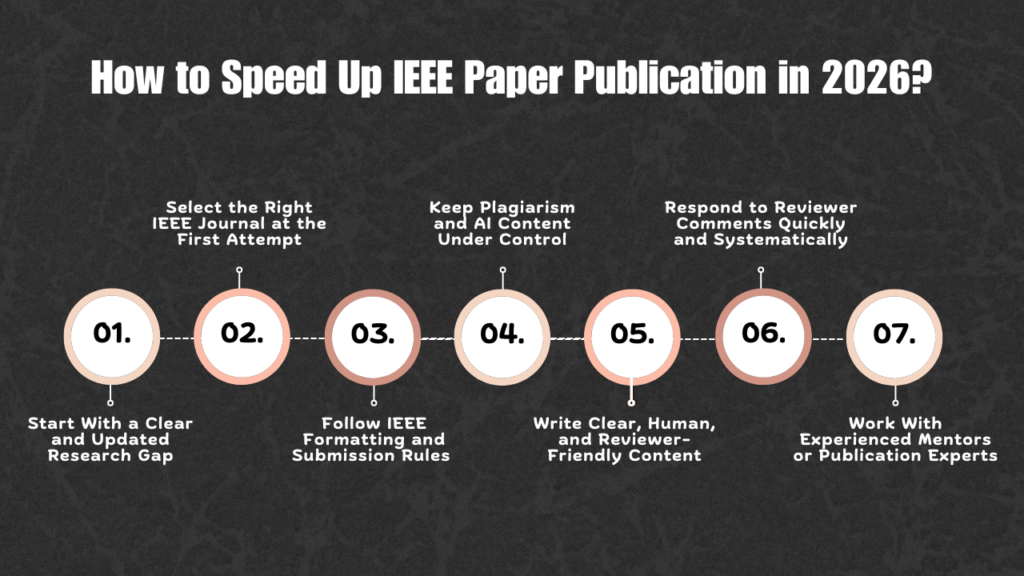
Start With a Clear and Updated Research Gap
One of the fastest ways to speed up IEEE publication in 2026 is to clearly define a strong research gap based on recent literature. Reviewers now expect references from the last five years, especially in fast-moving fields like AI, IoT, smart systems, and data science. When the novelty is clearly explained in the introduction itself, reviewers spend less time questioning the contribution. A well-defined gap reduces major revision requests and speeds up acceptance.
Select the Right IEEE Journal at the First Attempt
Journal mismatch is a major cause of delay. In 2026, IEEE editors prefer manuscripts that clearly fit their journal’s scope and current focus areas. Before submission, authors should carefully analyze recent issues and special calls. Submitting to the right journal at the first attempt avoids desk rejection and saves several months of resubmission time. Targeting fast-review IEEE journals or special issues aligned with your topic can significantly reduce publication timelines.
Follow IEEE Formatting and Submission Rules Without Exception
Even in 2026, many papers are delayed during IEEE research paper submission due to basic formatting issues. Editorial screening in the IEEE paper publication process has become stricter, and papers with incorrect templates, reference styles, or figure formats are often returned before peer review. Using the latest IEEE template and checking compliance through IEEE PDF eXpress helps avoid unnecessary resubmissions. Proper formatting demonstrates professionalism and allows the editor to send your paper directly into the review stage, speeding up the overall IEEE paper publication process.
Keep Plagiarism and AI Content Under Control
IEEE’s plagiarism and content-authenticity checks are much stronger in 2026. Papers with high similarity scores or excessive AI-generated language patterns often face delays or rejection. Authors should ensure the content is written in original language, with proper citations and human reasoning. AI tools may help with grammar or structure, but the technical explanation and research logic must clearly come from the author. Clean originality reports help papers move faster through editorial checks.
Write Clear, Human, and Reviewer-Friendly Content
Reviewers in 2026 value clarity more than complex wording. Papers written in simple, technical language are easier to review and often receive quicker decisions. Clearly explaining methodology, experiments, and results reduces reviewer confusion and follow-up questions. When reviewers understand your work in the first reading, they are less likely to ask for major revisions.
Respond to Reviewer Comments Quickly and Systematically
Revision handling is one of the most controllable stages in IEEE publication. Delayed or poorly structured responses can slow down decisions. In 2026, editors expect authors to submit revisions within the given timeframe with a clear, point-by-point response document. Each reviewer comment should be addressed respectfully, with exact changes mentioned. Highlighting revisions properly helps reviewers re-evaluate the paper faster and improves acceptance chances.
Work With Experienced Mentors or Publication Experts
First-time authors and PhD scholars often face delays during IEEE research paper submission due to limited experience with IEEE expectations. Collaborating with experienced co-authors or publication experts helps avoid common mistakes related to structure, scope, and reviewer communication. Expert guidance can reduce revision rounds, improve clarity, and significantly speed up the overall IEEE paper publication process.
Frequently Asked Questions (FAQs): Faster IEEE Paper Publication in 2026
1. How long does IEEE paper publication take in 2026?
IEEE paper publication in 2026 typically takes 3 to 9 months, depending on the journal, review cycles, and revision rounds. Delays usually happen due to desk rejection, major revisions, or slow author responses. Papers that meet scope, formatting, and originality requirements move faster.
2. Can I publish an IEEE paper within 1–2 months?
Practically, no IEEE journal guarantees 1–2 months. Fast decisions are rare and usually happen only if the paper fits the journal perfectly, is clearly written, and requires minor revisions. Most papers take at least 3 months to get the first decision.
3. Does IEEE allow AI-written papers in 2026?
AI tools may be used for grammar, readability, or formatting, but the research content, reasoning, and methodology must be authored by humans. Overreliance on AI-generated text can cause delays or editorial concerns.
4. Does choosing the wrong IEEE journal waste time?
Yes. Submitting to a journal that doesn’t fit your research can lead to desk rejection and resubmission, which can take 2–4 months extra.

Plan Your IEEE Submission Timeline Strategically
In 2026, timing also matters for IEEE research paper submission. Submitting during peak academic seasons can increase review delays due to reviewer overload. Planning submissions early and avoiding last-minute PhD or promotion deadlines helps ensure smoother progress through the IEEE paper publication process. IEEE publishing feels slow in 2026 mainly because standards are higher and competition is intense, but proper planning can reduce unnecessary delays. At kenfra research, we will do all kinds of PhD support, including IEEE paper writing, fast-track journal selection, plagiarism reduction, reviewer response preparation, and complete end-to-end publication guidance aligned with 2026 standards.








Leave a Reply