

How to Write the Methodology Chapter for a Thesis or Dissertation
Kenfra Research - Bavithra2026-02-23T09:34:52+05:30Writing the methodology chapter can feel overwhelming. Many students struggle with it because it is technical and detailed. But once you understand its purpose, it becomes much easier. In simple words, the methodology chapter explains how you conducted your research. It tells readers what you did, why you did it that way, and how your methods helped answer your research questions. This guide will walk you through how to write a strong methodology chapter for your thesis or dissertation in clear and practical steps.
Is the Methodology Different for a Thesis and a Dissertation?
Yes, the methodology differs between a thesis and a dissertation, primarily in scope, depth, and originality. The structure of the methodology chapter is generally the same for both. However:
Master’s Thesis
- Shorter and more focused
- Uses established research methods
- Smaller sample size
- Less complex design
PhD Dissertation
- More detailed and comprehensive
- Larger or more complex research design
- Strong theoretical justification
- May introduce new models or frameworks
- Requires deeper explanation of research philosophy and validity
Even though the depth differs, the core sections remain the same.
Step-by-Step Guide to Writing the Methodology Chapter
Here’s a clear, step-by-step approach to writing your methodology chapter.
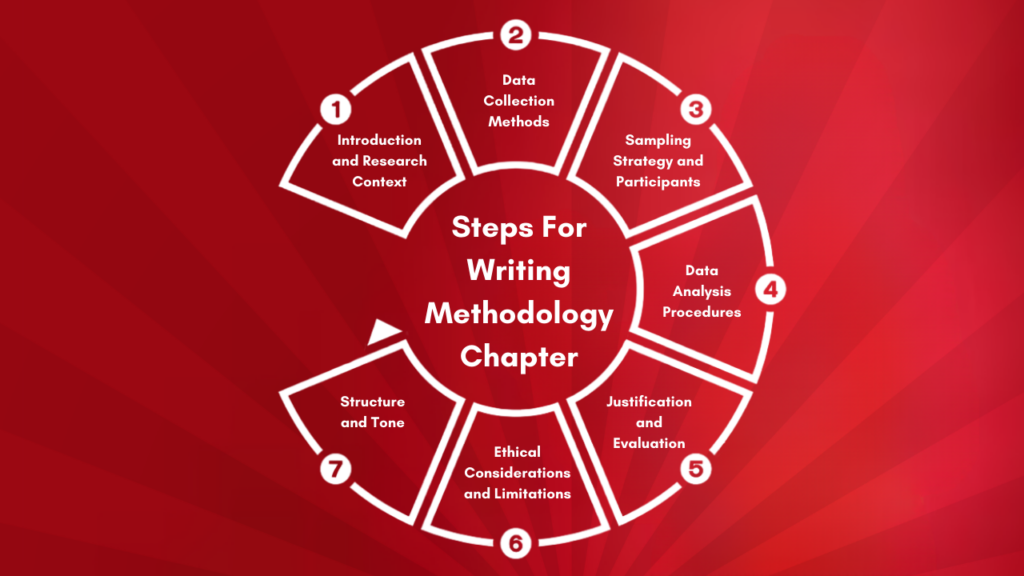
1. Introduction and Research Context
The first section of your methodology chapter should briefly introduce the purpose of the chapter and connect it to your research problem.
What to Include:
- A short overview of the research aim
- Research questions or hypotheses
- Research approach (qualitative, quantitative, or mixed methods)
- Context of the study (where and under what conditions it was conducted)
For Example:
This chapter explains the research design, data collection methods, sampling strategy, and data analysis procedures used to examine the impact of remote work on employee productivity.
Keep this section concise. Its purpose is to prepare the reader for the detailed explanation that follows.
2. Data Collection Methods
The data collection methods section explains how you gathered information to answer your research questions.
It is one of the most important parts of your methodology chapter.
Common Data Collection Methods:
- Surveys and questionnaires
- Interviews (structured, semi-structured, unstructured)
- Focus groups
- Observations
- Secondary data (reports, articles, databases)
What to Explain:
- Which method you used
- Why you selected it
- How the instrument was designed
- Where and when data was collected
- Whether the data was primary or secondary
Eg:
Data were collected using an online questionnaire consisting of 25 closed-ended questions measured on a 5-point Likert scale.
If you conducted interviews, mention:
- Duration
- Recording method
- Number of participants
- Type of interview
3. Sampling Strategy and Participants
This section explains who participated in your study and how they were selected.
Clear explanation of sampling strengthens the reliability and validity of your research.
Key Elements to Include:
- Target population
- Sample size
- Inclusion or exclusion criteria
Common Sampling Techniques:
- Random
- Convenience
- Purposive
- Stratified
Example:
The study used purposive sampling to select 40 teachers with at least three years of online teaching experience.
You should also mention:
- Response rate (if using surveys)
- Demographic details (age, gender, profession, etc.)
4. Data Analysis Procedures
After collecting data, you need to explain how you analyzed it. This section shows how raw information was transformed into meaningful findings.
Quantitative Research:
Mention:
- Statistical software (if used)
- Descriptive statistics (mean, percentage, frequency)
- Inferential statistics (regression, correlation, t-test, ANOVA)
The Example:
Collected data were analyzed using descriptive statistics and regression analysis to test the research hypotheses.
Qualitative Research:
Explain:
- Coding process
- Thematic analysis
- Content analysis
- Pattern identification
Example:
Interview transcripts were coded and grouped into themes to identify recurring patterns related to workplace motivation.
Make sure you describe the steps clearly, not just name the method.
5. Justification and Evaluation
This section explains why you chose your methods and evaluates their strengths and weaknesses.
Many students forget this part, but it is very important.
What to Include:
- Why your chosen methods were suitable
- Advantages of your approach
- Possible weaknesses
- How you minimized errors
For Example:
A quantitative approach was chosen because it allowed measurement of relationships between variables in a structured and objective manner.
You can also briefly discuss:
- Validity (accuracy of measurement)
- Reliability (consistency of results)
6. Ethical Considerations and Limitations
Ethical considerations are essential in any research involving people or data.
Ethical Considerations
You should explain:
- Informed consent
- Voluntary participation
- Confidentiality
- Data protection
- Approval from an ethics committee (if applicable)
Eg:
Participants were informed about the purpose of the study and provided written consent before participation.
Limitations of the Study
No study is perfect. Acknowledge limitations honestly.
Common limitations include:
- Small sample size
- Limited time frame
- Restricted geographic area
- Self-reported data
Example:
One limitation of this study is the small sample size, which may limit the generalizability of the findings.
7. Structure and Tone
The structure and tone of your methodology chapter are just as important as the content.
Structure Tips:
- Use clear headings and subheadings
- Follow your university guidelines
- Present information in logical order
- Avoid mixing results into this chapter
A standard structure often looks like:
- Introduction
- Research Design
- Data Collection Methods
- Sampling Strategy
- Data Analysis
- Validity and Reliability
- Ethical Considerations
- Limitations
Tone Tips:
- Write in past tense
- Use formal academic language
- Be clear and precise
- Avoid unnecessary jargon
- Do not use emotional or informal language
Tone Example:
Instead of writing:
I decided to use surveys because I thought they were easier.
Write:
A survey method was selected due to its efficiency in collecting quantitative data from a large sample.
This keeps your dissertation methodology professional and academic.
Frequently Asked Questions
1. How to Write a Methodology Step by Step?
Follow these steps: research design → research approach → population & sample → data collection → data analysis → validity & reliability → ethical considerations.
2. What Are the 5 Steps of Methodology?
- Define research problem
- Choose research design & approach
- Select population & sample
- Collect data
- Analyze data and report methods
3. What Is a Writing Methodology?
It’s the part of your thesis/dissertation where you explain how you conducted research, how you analyzed data, and why your methods were chosen.
4. How to Write a Methodology for a Dissertation Example?
This dissertation uses a quantitative research design to study the impact of social media on student performance. A deductive approach was adopted. The population included 300 undergraduate students, with 150 selected through stratified random sampling. Data was collected using a structured questionnaire and analyzed using SPSS software. Reliability was tested with Cronbach’s alpha, and ethical approval was obtained from the university committee.
5. Is Methodology Chapter 3 or 4?
- Usually, Chapter 3
- Sometimes, if combined with literature review, it may be Chapter 4
6. How Long Should a Methodology Chapter Be?
- Master’s thesis: ~2,000–3,000 words
- PhD dissertation: ~5,000–7,000 words
- Focus on clarity and completeness, not word count
7. Does Kenfra Research help me in dissertation writing?
Yes. Kenfra Research offers one of the best dissertation writing services in India, providing professional guidance, topic selection, research support, and full dissertation assistance.

Final Thoughts
The methodology chapter is not just a technical requirement. It is the foundation of your thesis or dissertation. It proves that your research was conducted systematically and ethically.
To write a strong methodology chapter:
- Be clear
- Be detailed
- Justify your choices
- Use structured headings
- Follow academic guidelines
For students seeking expert guidance, Kenfra Research the best PhD Consultancy services in India offer professional support. They can help you design your methodology, choose the right research methods, and ensure your dissertation meets high academic standards.









Leave a Reply