

IEEE Access Acceptance Rate in 2026: Trends, Data & Author Success Tips
Kenfra Research - Bavithra2026-02-25T17:28:41+05:30Publishing in a high-quality journal plays an important role for researchers, students, and professionals. Many authors choose IEEE Access as a popular journal in engineering, computer science, and technology. This open-access journal receives thousands of submissions every year.
If you plan to submit your research, you should understand the IEEE Access acceptance rate in 2026, current trends, and effective author tips to increase your chances of publication. In this article, we explain everything in simple, clear language.
What is IEEE Access?
IEEE Access is a multidisciplinary open-access journals published by the IEEE (Institute of Electrical and Electronics Engineers). It covers research in many technical fields, including:
- Electronics and Electrical Engineering
- Computer Science and AI
- Robotics and Automation
- Communications and Networking
The main benefits of publishing in IEEE Access are:
- Fast review and publication: Decisions are often made in 4–6 weeks.
- High visibility: Papers are indexed in IEEE Xplore, reaching a global audience.
- Open access: Your research is free for anyone to read.
Because of these advantages, IEEE Access has become a popular choice for researchers worldwide.
IEEE Access Acceptance Rate in 2026
The acceptance rate for IEEE Access in 2026 is around 27%. This means that the journal publishes roughly 1 in 4 submitted papers.
What does this mean for authors?
- IEEE Access is moderately selective. It is not as competitive as top-tier journals with acceptance rates below 10%, but the journal still enforces high quality standards.
- Authors should write a strong, relevant, and carefully prepared manuscript.
- Understanding this acceptance rate helps new authors set realistic expectations.
Acceptance Rate Trends: Is IEEE Access Getting More Competitive?
Over the past few years, IEEE Access has received a high number of submissions due to:
- Fast review process
- Open access visibility
- Broad scope
- Strong indexing
As submissions increase, the journal has gradually become more selective. While it was once considered easier than many IEEE journals, competition has increased in 2026.
Compared to other journals under IEEE, the acceptance rate of IEEE Access is:
- Higher than many IEEE Transactions journals (10–20%)
- Lower than some regional or lesser-known engineering journals
This places IEEE Access in a moderately competitive category.
Why Papers Get Rejected in IEEE Access?
Even with a 25–35% acceptance rate, many papers are rejected. Understanding common rejection reasons can help you prepare better.
1. Lack of Novelty
If your research does not clearly show new contribution compared to existing work, it may not pass peer review.
2. Weak Methodology or Results
Insufficient experiments, missing comparisons, or poor validation often lead to rejection.
3. Poor Structure and Writing
Even strong research can be rejected if it is poorly written or difficult to understand.
4. Out of Scope
IEEE Access covers many fields, but the research must still align with engineering, technology, or IEEE-related areas.
5. High Similarity or Ethical Issues
Plagiarism or improper citations can result in immediate rejection.
Understanding the IEEE Access Review Process
Knowing the review process helps you improve your chances of acceptance:
- Initial Screening: Editors check for formatting, plagiarism, and scope alignment. Some papers are rejected at this stage.
- Peer Review: Experts evaluate technical accuracy, novelty, and significance.
- Decision: Papers are either accepted, rejected, or sent for revision. Responding carefully to reviewer comments is critical for eventual acceptance.
By understanding these steps, authors can prepare a stronger manuscript that meets the journal’s expectations.
Common Misconceptions About IEEE Access
Some common misunderstandings include:
- “Open access means easy acceptance.”
In reality, quality research is still required. - “Fast review means low standards.”
IEEE Access maintains strict review criteria even with quick decisions. - “Acceptance rate determines difficulty.”
While acceptance rate gives an idea of selectivity, the quality of your manuscript matters more than statistics.
Author Success Tips to Increase Acceptance Chances
If you want to publish in IEEE Access in 2026, focus on quality rather than shortcuts.
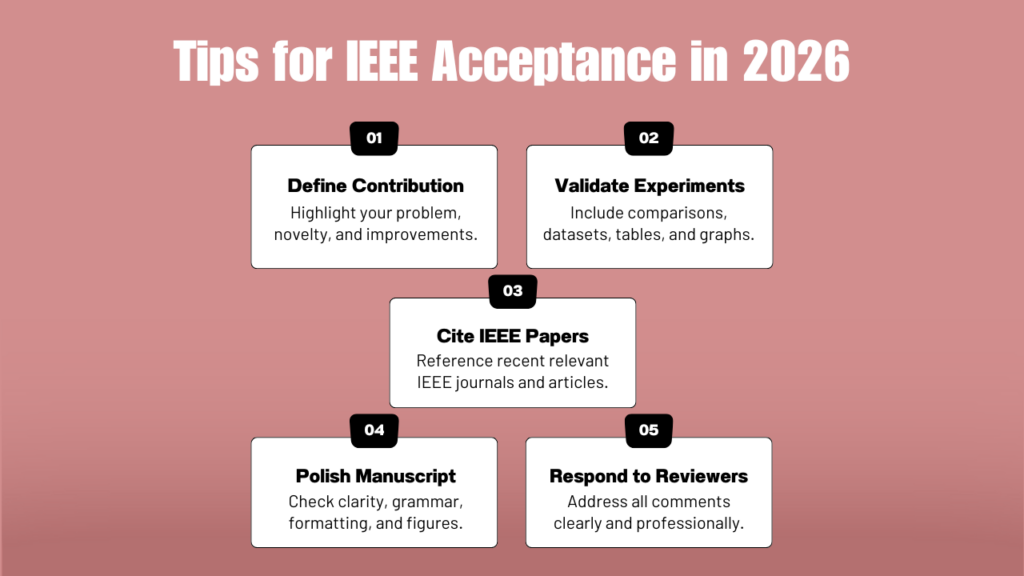
1. Clearly Define Your Contribution
Add a clear “Contributions” section. Explain:
- What problem you solve
- What is new
- How it improves existing methods
Reviewers look for originality first.
2. Strengthen Experimental Validation
Engineering journals value strong technical evidence. Include:
- Comparisons with recent methods
- Real datasets
- Performance tables
- Clear graphs and analysis
Solid results increase credibility.
3. Cite Relevant IEEE Papers
Show that your work fits the journal’s scope by referencing:
- Recent IEEE Access articles
- Related IEEE journals
This signals relevance and awareness of current research trends.
4. Improve Manuscript Quality Before Submission
Before submitting:
- Check grammar and clarity
- Follow IEEE formatting strictly
- Ensure figures and tables are clear
- Verify references
A well-prepared manuscript creates a positive first impression.
5. Respond Carefully to Reviewers
Most accepted papers go through major or minor revisions. When revising:
- Answer every reviewer comment clearly
- Provide evidence for changes
- Remain professional and respectful
A strong revision response often leads to final acceptance.
Frequently Asked Questions
1. What is the IEEE Access acceptance rate in 2026?
The IEEE Access acceptance rate in 2026 is approximately 27%. This means roughly one in four submitted papers is accepted. While the journal is moderately selective, preparing a high-quality, clear, and relevant manuscript can significantly improve your chances of acceptance.
2. Is IEEE Access a high-quality journal for publication?
Yes, IEEE Access is considered a high-quality journal in engineering, computer science, and technology fields. It is indexed in IEEE Xplore, provides wide visibility, and follows a rigorous peer review process, making it a credible platform for researchers seeking impactful publications.
3. How can I improve my chances of getting published in IEEE Access?
To increase your chances:
- Clearly define your research contributions.
- Strengthen experimental validation with real datasets and comparisons.
- Cite relevant IEEE papers to show alignment with the journal’s scope.
- Follow IEEE formatting guidelines and check manuscript clarity.
- Respond carefully and professionally to reviewer comments.
Platforms like Kenfra Research can provide guidance to prepare high-quality journal publications and navigate the submission process successfully.
4. What is the review process for IEEE Access?
The IEEE Access review process includes:
- Initial Screening: Editors check formatting, plagiarism, and relevance.
- Peer Review: Experts evaluate technical accuracy, originality, and significance.
- Decision: Papers are accepted, rejected, or sent for revision.
Responding carefully to reviewer comments is key to eventual acceptance.
5. Is IEEE Access suitable for fast publication?
Yes, one of the advantages of IEEE Access is its fast review and publication timeline, typically 4–6 weeks. This makes it an attractive choice for researchers who want quick publication without compromising quality.

Conclusion
In 2026, IEEE Access accepts approximately 27% of submitted manuscripts, which makes it a moderately selective journal. While the acceptance rate reflects the level of competition, authors improve their chances by preparing high-quality, relevant, and clearly written research.
By following the tips above, authors can increase their chances of acceptance and contribute meaningful research to the global community. IEEE Access provides quick publication, wide visibility, and strong credibility, which makes it an excellent platform for engineers, computer scientists, and technology researchers.
For researchers looking to achieve high-quality journal publication, platforms like Kenfra Research can provide guidance, support, and insights into preparing manuscripts for journals like IEEE Access.







Leave a Reply