chit fund vs bank rd

Is Chit Fund Safe Compared to Bank RD in India?
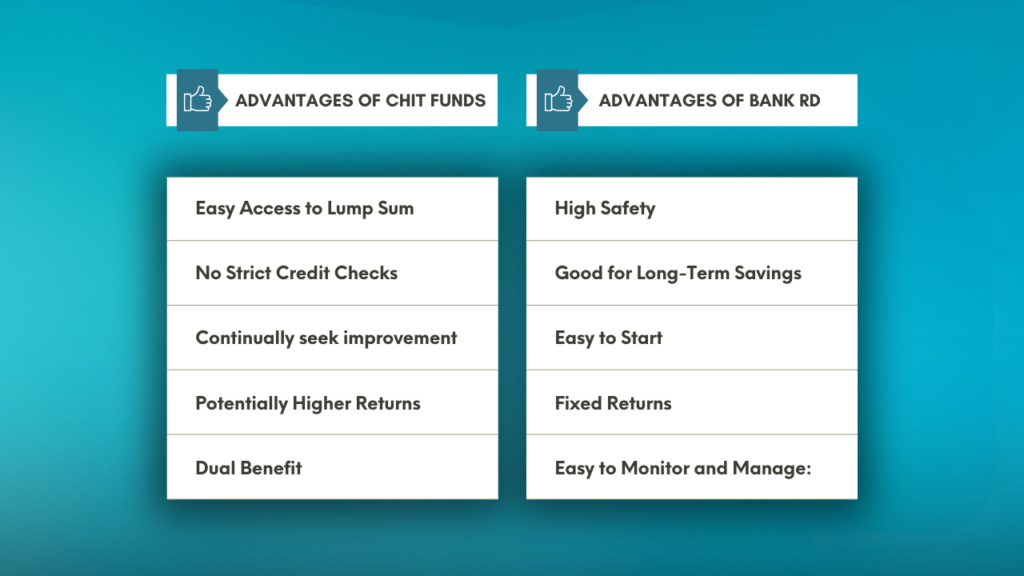

Saving money regularly is one of the best habits for financial stability. In India, two common ways people save monthly are Chit Funds and Recurring Deposits (RDs) offered by banks. Both options allow you to deposit a fixed amount every month and build a lump sum over time. Many people often ask an important question: Is a chit fund safe compared to a bank RD? If you’re wondering the same, this article will guide you through Chit Fund vs Bank RD, explaining how each works, their risks and benefits, and which option is safer for Indian savers.

What is a Chit Fund?

A chit fund is a type of savings and borrowing system commonly used in India. It is a group‑based financial arrangement where members contribute a fixed amount every month for a specific period. Many people now even use finance app to track their contributions and payments, making it easier to manage and stay organized.

Here is how it usually works:

  1. A group of people join a chit fund scheme.
  2. Each member contributes a fixed amount every month.
  3. The total collected amount becomes the monthly chit value.
  4. Every month, the amount is given to one member through an auction or lucky draw.
  5. This continues until all members receive the amount once.

For example:

  • 20 members join a chit fund
  • Each contributes ₹5,000 per month
  • Total monthly pool = ₹1,00,000
  • Every month one member receives the amount

Members who take the amount earlier usually bid a discount, and the remaining members share that benefit. Recurring deposits are considered one of the best safe investment options in India for people who want stable and predictable returns.

Chit funds are often used by people who want both savings and quick access to funds.

What is a Bank Recurring Deposit (RD)?

A Recurring Deposit (RD) is a savings scheme offered by banks where you deposit a fixed amount every month for a fixed period. Many people use personal finance app to track their RD contributions and maturity amounts easily.

For example:

  • Monthly deposit: ₹5,000
  • Tenure: 3 years
  • Interest rate: 6.5% (example)

At the end of the tenure, you receive:

Total deposits + interest earned

Key features of RD:

  • Fixed monthly deposits
  • Guaranteed returns
  • Safe and regulated by banks
  • No auction or bidding process

This makes RDs one of the simplest and safest saving options in India.

Chit Fund vs Bank RD: Key Differences

Types of Chit Funds in India

Not all chit funds are unsafe. There are different types:

Registered Chit Funds

These funds are regulated under Chit Funds Act, 1982.

Features:

  • Government registered
  • Legal agreements
  • More transparency

These are safer than informal chit funds.

Unregistered Chit Funds

These are commonly called private or local chit schemes.

Risks include:

  • No government oversight
  • Organizer may run away with money
  • Lack of legal protection

Many financial scams in India have happened through illegal chit funds, so caution is necessary. To stay safe, you can use trusted chit fund app to track contributions, payments, and auctions securely.

Which is Safer: Chit Fund or Bank RD?

When it comes to safety, bank RDs are clearly the safer option in the Chit Fund vs Bank RD comparison.

Reasons:

  • Banks are regulated by the Reserve Bank of India (RBI).
  • Deposits are structured and transparent.
  • Returns are guaranteed and predictable.

Chit funds can be safe only if they are properly registered and managed by trustworthy companies. However, many financial advisors suggest avoiding informal chit schemes because of fraud risks.

Chit Fund vs Bank RD in India

When Should You Choose a Chit Fund?

A chit fund may be suitable if:

  • It is government registered
  • The organizer has a strong reputation
  • You need the possibility of early funds
  • You understand the risks involved

Even then, it is better not to invest all your savings in chit funds.

When Should You Choose a Bank RD?

A recurring deposit is better when:

  • You want safe and guaranteed savings
  • You prefer predictable returns
  • You are saving for goals like education, travel, or emergencies
  • You want low risk investment options

For most salaried individuals and families, RD is the safer and simpler option.

Frequently Asked Questions

1. What are the disadvantages of chit funds?

  • High risk if the chit fund is not registered.
  • Depends on other members paying on time; delays can happen.
  • Returns are not guaranteed and vary each month.
  • Hard to get your money back if the organizer cheats.

2. Is a chit fund better than a fixed deposit (FD)?

  • Chit fund: Can give higher returns and early access to money but is risky.
  • FD: Offers safe and fixed returns, making it better for long-term savings.

If you want safety and predictable growth, choose an FD.

3. Is income from chit funds taxable?

Yes. Money earned from chit funds is taxable as income. It depends on your income tax slab, and sometimes TDS (Tax Deducted at Source) applies. Some chit fund app may also deduct TDS (Tax Deducted at Source) automatically, making it easier to stay compliant.

4. What is the average return on chit funds in India?

  • Returns are not fixed and depend on when you get the money.
  • Registered chit funds usually give around 8–15% per year.
  • Unregistered chit funds may promise more, but they are very risky.
Is Chit Fund Safe Compared to Bank RD in India

Final Thoughts

Both chit funds and bank recurring deposits (RDs) help you save monthly, but they work differently. In the Chit Fund vs Bank RD comparison, chit funds allow for both saving and borrowing but carry higher risks if unregulated. On the other hand, bank RDs provide safe, guaranteed returns, making them one of the most secure saving options in India. For secure and steady growth, bank RD is usually better. If you consider a chit fund, ensure it is registered and trustworthy. Use Kenfra Finstar, the best finance application in India, to manage your savings and make smart financial decisions.

Share this post

Leave a Reply

Your email address will not be published. Required fields are marked *