proofreading for phd thesis

Lost in Errors? How Proofreading Restores Credibility and Confidence

When writing a PhD thesis, the journey toward completion can be a challenging one. From formulating complex arguments to presenting detailed research findings, it’s easy to overlook small errors that can undermine the strength of your work. This is where proofreading for PhD thesis becomes crucial. A thorough review can help restore credibility and confidence in your research, ensuring that your final submission is as polished and professional as possible.

Why Proofreading for PhD Thesis Matters?

Proofreading for PhD thesis isn’t just about fixing typos or grammatical mistakes. It’s an essential step to ensure that your arguments are clear, your references are accurate, and your work meets the high academic standards expected in a doctoral program. Small errors can distract readers, create confusion, or even raise questions about the validity of your research. By dedicating time to proofreading, you give your thesis the best chance of success.

The Impact of Proofreading on Thesis Quality

Proofreading can improve the overall structure and flow of your thesis. It helps identify awkward sentence structures, inconsistencies in terminology, or areas where your argument could be stronger. By eliminating distractions and refining your writing, proofreading increases the clarity of your research, allowing your findings to shine through without any confusion or ambiguity.

Common Areas to Focus on During Proofreading

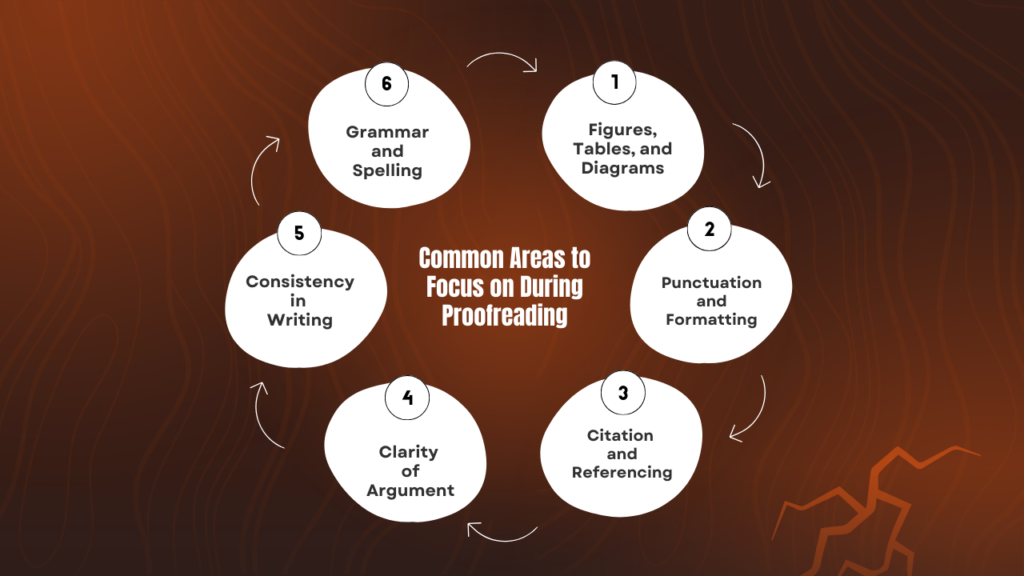
Common Areas to Focus on During Proofreading

1. Grammar and Spelling

Even the smallest grammatical errors can be detrimental to your thesis. Checking for spelling mistakes, incorrect punctuation, and sentence structure is essential for readability. Pay attention to subject-verb agreement and tense consistency.

2. Consistency

Your thesis should maintain consistency in language, style, and formatting. Proofreading ensures uniformity across headings, subheadings, and references. This includes checking for consistency in terms of spelling (e.g., American vs. British English) and abbreviation use.

3. Clarity of Argument

During proofreading, it’s important to check whether your argument flows logically and whether the points you make are clearly supported by evidence. Ensure that each paragraph transitions smoothly and builds upon the previous one.

4. Citation and Referencing

Ensure that all references are cited properly and in the correct format, which is crucial for academic credibility. Double-check that in-text citations match your reference list.

5. Punctuation and Formatting

Small punctuation mistakes, such as missing commas or misplaced periods, can confuse readers. Ensure that punctuation is used correctly and the overall formatting follows the guidelines.

6. Figures, Tables, and Diagrams

Ensure that all visual elements in your thesis are properly labeled and referenced in the text. Verify that the captions are clear and accurate.

FAQs on Proofreading for PhD Thesis

1. How do I start proofreading my PhD thesis?

Start by reading your thesis aloud to catch errors you might miss while reading silently. Focus on different aspects of your writing, such as grammar, clarity, and formatting.

2. Should I proofread my thesis in one go?

It’s better to break it up into sections to avoid overlooking errors. Proofreading small sections at a time will help you catch more mistakes.

3. Can I use proofreading software for my PhD thesis?

While software tools can catch some mistakes, they can’t replace the value of a human proofreader who understands the academic context. It’s always best to proofread your thesis manually, with or without software.

4. When should I proofread my PhD thesis?

Proofreading should be done after completing the main draft, once you’ve reviewed your work for content and structure. Give yourself time to step away from your thesis before doing a final proofread.

Proofreading Services

Conclusion

In the world of academic writing, proofreading for PhD thesis is a vital step to ensure your research is presented in the best possible light. It allows you to catch errors that could distract from the quality of your work and helps you refine your arguments. At Kenfra Research, we understand the importance of a flawless thesis. We provide comprehensive PhD support, including expert proofreading services, to help you achieve your academic goals with confidence. Let us help you present a polished, error-free thesis that demonstrates the quality of your research.

Share this post

Leave a Reply

Your email address will not be published. Required fields are marked *