12Sep
Preparing for your Viva Voce Questions and Answers session can be both exciting and nerve-wracking. The Viva Voce is a critical oral defense where you must demonstrate your knowledge, research depth, and analytical thinking. In this comprehensive guide, we’ll walk you through the most frequently asked Viva Voce questions and smart answers, helping you prepare effectively and boost your confidence. Whether you’re defending your thesis or facing an academic oral exam, mastering these questions will significantly improve your chances of success.
In this article, we’ll not only highlight the common Viva Voce questions, but also provide a well-structured Viva Voce Question Bank, actionable Viva Voce Preparation Tips, and sample smart answers.
Understanding the type of questions typically asked during a Viva Voce presentation helps in better preparation. Below are the categories of frequently asked questions:
Answering Viva Voce Questions effectively requires a balance between confidence and honesty. Here are key strategies:
Never memorize answers. Understand your research problem, methodology, results, and conclusions deeply. This builds confidence when responding to any unexpected questions.
Avoid long-winded answers. Aim for clarity and brevity, focusing on the core of your research findings.
When asked about limitations, acknowledge them candidly and demonstrate how you accounted for them.
Whenever applicable, link your findings to the existing body of research to show a comprehensive understanding of the subject.
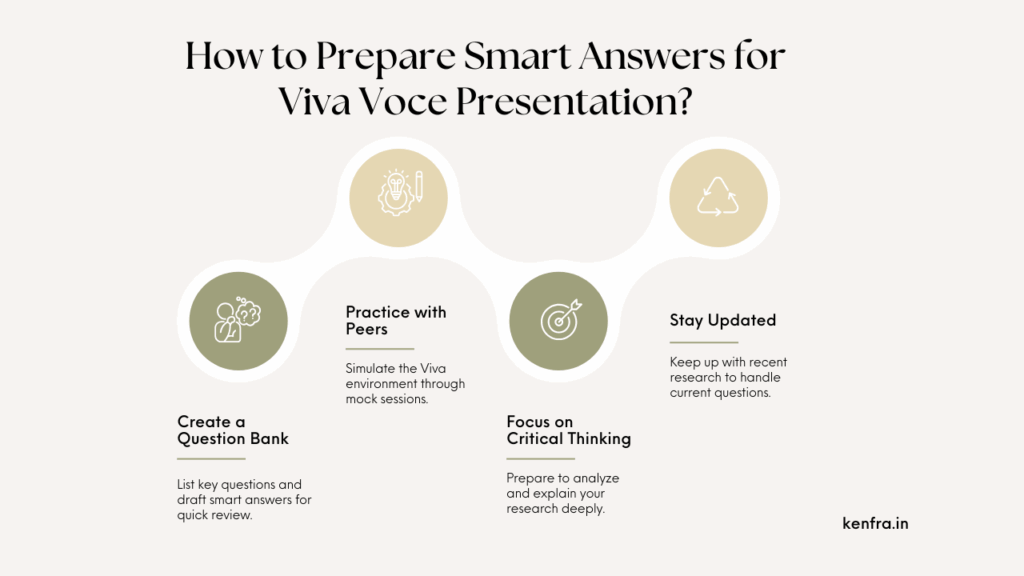
Preparation is the key to success. Below are effective steps recommended by Kenfra Research:
Let’s review some sample smart answers that stand out:
Following are expert-recommended Viva Voce Preparation Tips:
Mastering the Viva Voce Questions and Answers is essential for academic success. By focusing on the common Viva Voce questions, implementing smart strategies for answers, and using the Viva Voce Question Bank, you’ll be well-prepared for your oral defense.
The University Grants Commission (UGC) 12B status refers to the recognition given to higher education institutions in India. The UGC... read more
In academic writing, terms like literature review and literature survey are often used interchangeably, leading to confusion. However, they... read more
A PhD literature review is more than just a summary of existing research—it's a critical foundation for your thesis... read more
IIoT is a environment created to screen and go with choices on the information. This examination field is famous and... read more
Writing a PhD manuscript is a rigorous process that requires precision, clarity, and coherence. However, the initial draft is... read more
A well-defined PhD Dissertation Research Problem is the foundation of a successful PhD dissertation. It sets the direction for... read more
The trend of increased funding from alumni to engineering colleges and business schools is not uncommon. Alumni often feel a... read more
It's wonderful to hear that there has been a significant increase in the enrollment of girls in engineering courses in... read more
WhatsApp us
Leave a Reply