

The Base Paper: Your PhD’s First Power Move!
Kenfra Research - Bavithra2025-12-18T16:37:20+05:30Starting a PhD is not just about enrolling in a program it is about making the right research decisions from day one. Among these, the selection and understanding of a base paper for PhD is the first and most critical power move a scholar makes.
A base paper is not merely a reference. It is the research backbone on which your proposal, methodology, experiments, publications, and final thesis are built. A strong base paper provides clarity, direction, and momentum, while a weak one can delay progress for years.
Many students are first exposed to this concept while working on a base paper for project, but at the doctoral level, its importance increases exponentially.
What Is a Base Paper? – Meaning and Importance
Students often ask:
- What is a base paper in project?
- What is base paper project work?
In simple terms, a base paper is a well-established research article that you critically analyze and extend. It helps you:
- Understand existing methodologies
- Identify research gaps
- Propose meaningful improvements or innovations
The base paper meaning remains consistent across academic levels mini projects, final year projects, and PhD but the depth of analysis, originality, and contribution increase significantly at the doctoral stage.
For a PhD, a base paper is never copied or lightly modified. Instead, it acts as a starting framework for advanced, original research.

Base Papers in Academic Projects: From Learning to Research
Most students first encounter base papers during undergraduate or postgraduate studies. Faculty members often provide a base paper for project sample to help students understand research structure and methodology.
- In early semesters, students work on a base paper for mini project
- Later, they explore a base paper for final year project
These academic exercises prepare scholars to understand how real research works—skills that become crucial during PhD research, where independent thinking and innovation are mandatory.
Base Paper for PhD and IEEE Research Work
In engineering, technology, and computer science disciplines, scholars frequently rely on IEEE base paper references. When students ask what base paper IEEE means, the answer lies in understanding the quality and structure of IEEE journals and conference papers.
A typical IEEE base paper for project includes:
- Clear problem definition
- Comprehensive literature review
- Well-defined methodology
- Experimental validation and results
Many students look for IEEE base paper downloads to study formatting and research flow. While this is useful for learning, PhD research demands original contributions, not imitation.
Role of a Base Paper in Research-Oriented Studies
When scholars transition from coursework to independent research, the question what is base paper in research becomes central.
In research, a base paper helps you:
- Identify unexplored or weakly explored research gaps
- Understand limitations of existing models and algorithms
- Design improved, scalable, or novel solutions
Unlike academic projects, research base papers require clear novelty, validation, and justification. Your PhD work must explicitly demonstrate how it advances knowledge beyond the base paper.
How to Find the Right Base Paper for PhD?
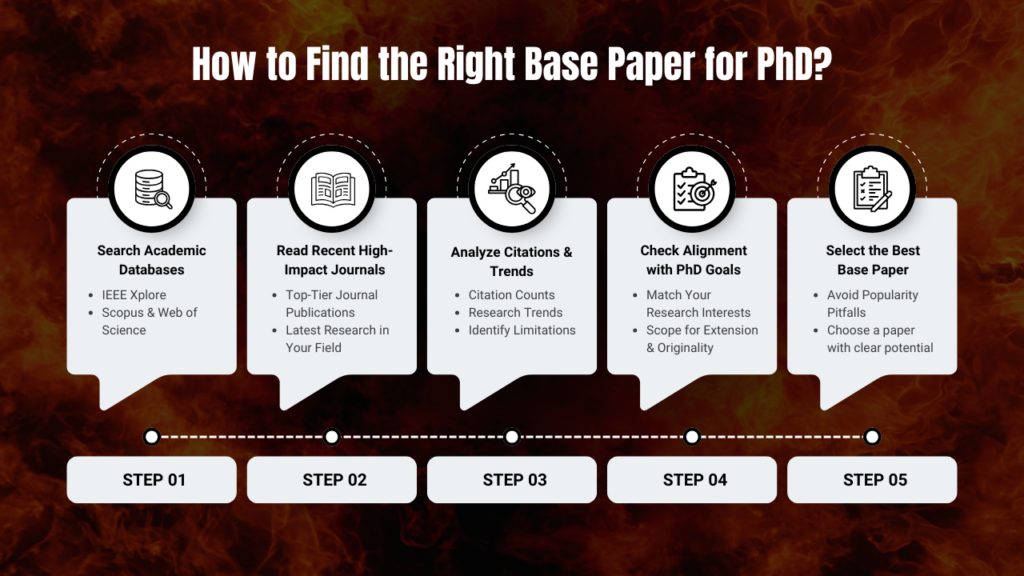
One of the biggest challenges scholars face is how to find the right base paper. The same process applies to projects and PhD research but with far stricter standards at the doctoral level.
Effective ways to identify a strong base paper include:
- Searching databases like IEEE Xplore, Scopus, and Web of Science
- Reading recent high-impact journal publications
- Analyzing citation counts, research trends, and limitations
- Checking alignment with your long-term PhD objectives
Avoid selecting a paper solely because it is popular or frequently cited. A good base paper must offer clear scope for extension, originality, and multi-publication potential.
Frequently Asked Questions
1. What is base paper?
A base paper is any research paper that serves as a foundation for your project, mini project, final year project, or PhD research.
2. What is IEEE base paper for project?
An IEEE base paper for project is a research paper published in IEEE journals or conferences that you use to learn methods and structure for your project.
3. What mistakes should be avoided while selecting a base paper?
Common mistakes include choosing papers only because they are highly cited, outdated, too narrow, or difficult to extend. Selecting a paper without understanding its limitations or future scope can significantly affect PhD progress.
4. Where can I find the right base paper for my PhD?
You can find a good base paper by searching academic databases like IEEE Xplore, Scopus, and Web of Science. Focus on recent, high-quality journal papers that match your PhD goals and offer clear scope for original research.
Final Conclusion
The base paper for PhD is not just a reference it is your first strategic academic decision and the foundation of your entire doctoral journey. Whether you first learned the concept through a base paper for project, IEEE research work, or academic journals, its importance multiplies at the PhD level.
Choosing the right base paper, deeply understanding its structure, and extending it with clear originality and strong validation can define the success of your PhD.
If you need expert support with base paper selection, IEEE research papers, research gap identification, journal publication, or complete doctoral guidance, Kenfra Research provides end-to-end PhD support from base paper preparation to thesis completion.






Leave a Reply