
UGC CARE List vs Scopus: What’s the Difference?
Kenfra Research - Bavithra2026-02-24T12:32:12+05:30When it comes to academic research and publishing, two names often come up: UGC CARE List vs Scopus. Many students, teachers, and scholars get confused about these terms and how they differ. This article explains what the UGC CARE List and Scopus are, their key differences, and why each is important for academic publishing.
What is UGC CARE List?
The UGC CARE List is created by the University Grants Commission (UGC), India. CARE stands for Consortium for Academic and Research Ethics.
Purpose of UGC CARE List
The main goal of UGC CARE is to:
- Stop fake and predatory journals
- Promote quality research publications
- Help Indian researchers choose trusted journals
UGC introduced the CARE List to replace the old “UGC Approved Journal List,” which had many low-quality journals.
What is Scopus?
Scopus is a large database of academic journals, books, and conference papers. It is not a list made by a country, but a global citation and abstract database created by Elsevier, one of the world’s biggest academic companies.
Scopus is widely used by:
- Universities
- Researchers
- Librarians
- Publishers
It tracks how often articles are cited and helps measure the impact of research papers.
Scopus includes:
- Journals from many countries
- High‑quality research publications
- Citation metrics like h‑index, CiteScore, SJR, and SNIP
In simple words: Scopus measures how often research is read and cited by others around the world.
Key Differences Between UGC CARE List and Scopus
The differences between the UGC CARE List vs Scopus can be understood through several dimensions:
UGC CARE vs Scopus for PhD
This is one of the most searched questions online: Which is better for PhD – UGC CARE or Scopus? If you simply aim to meet the minimum requirement for PhD submission in India, publishing in a UGC CARE listed journal usually suffices.
However, if you want to build a strong academic profile, improve your CV, and increase your research impact, publishing in a Scopus indexed journal offers a better choice. Many Indian universities now accept Scopus indexed journals for:
- PhD submission
- Faculty recruitment
- Promotions
- Academic performance evaluation
So, while UGC CARE fulfills eligibility requirements, Scopus helps enhance career growth.
Types of UGC CARE Journals
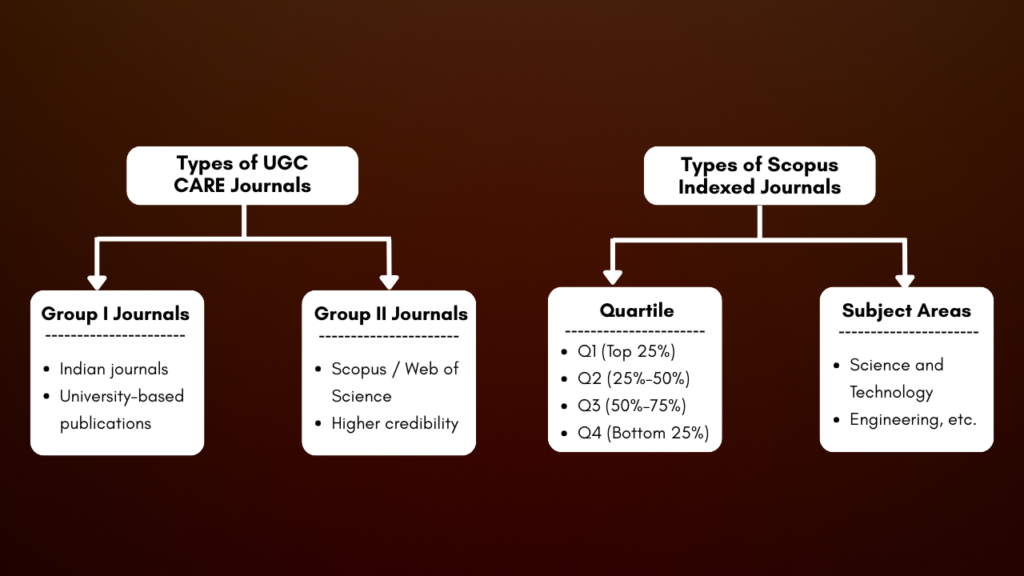
The University Grants Commission in India manages the UGC CARE List. It divides the list into two main groups.
1. Group I Journals
Group I includes journals that are:
- Recommended by the UGC CARE committee
- Evaluated for research ethics and quality
- Approved for academic use in India
These journals are mainly:
- Indian journals
- Subject-specific journals
- University-based publications
These journals are suitable for:
- PhD scholars in India
- Assistant Professor eligibility
- Academic Performance Indicator (API) score
- University promotion requirements
If your goal is to meet minimum academic compliance in India, Group I journals are usually enough.
2. UGC CARE Group II Journals
Group II includes journals indexed in internationally recognized databases such as:
- Scopus
- Web of Science
This means that many Scopus indexed journals fall under UGC CARE Group II.
Group II journals offer:
- National recognition (UGC compliance)
- International indexing
- Higher credibility
Publishing in Group II journals gives dual benefits — both Indian academic approval and global visibility.
Types of Scopus Indexed Journals
Let us now understand the types of journals that Scopus indexes, which Elsevier owns.
Scopus journals are classified in different ways. The two main classifications are:
- Based on Quartiles (Q1, Q2, Q3, Q4)
- Based on Subject Areas
1. Scopus Quartile Types (Q1, Q2, Q3, Q4)
One of the most important classifications in Scopus is journal quartiles. Journals are ranked into four quartiles based on their impact and performance.
Q1 Journals (Top 25%)
- Highest-ranked journals
- Very high impact and citation rate
- Strong international reputation
- Strict peer-review process
Publishing in Q1 journals is considered prestigious. These journals are ideal for:
- Senior researchers
- International collaborations
- High-impact research
Q2 Journals (25%–50%)
- Good quality journals
- Moderate to high impact
- Competitive but slightly easier than Q1
Q2 journals are a strong option for PhD scholars who want international recognition but may not yet reach Q1 level.
Q3 Journals (50%–75%)
- Moderate impact journals
- Suitable for early-career researchers
- Easier compared to Q1 and Q2
Many PhD students publish in Q3 journals to build their research profile.
Q4 Journals (Bottom 25%)
- Basic level Scopus indexed journals
- Lower citation impact
- Easier acceptance rate
Although Q4 journals are indexed in Scopus, they have lower impact compared to higher quartiles.
2. Types Based on Subject Areas
Scopus also classifies journals by subject categories. Some major categories include:
- Science and Technology
- Engineering
- Medicine
- Social Sciences
- Arts and Humanities
- Business and Management
Each subject area has its own ranking and quartile system.
For example:
- An Engineering journal may be Q1 in Engineering but Q2 in a broader category.
- A Business journal may be Q3 but still highly relevant within its niche field.
So, always check the subject-specific ranking before choosing a journal.
Types Based on Access Model
Scopus journals also differ based on publishing model.
1. Open Access Journals
- Articles are freely available to everyone
- Authors usually pay Article Processing Charges (APC)
- Higher visibility
2. Subscription-Based Journals
- Readers or institutions pay for access
- Sometimes lower publication charges for authors
Both types can be Scopus indexed. The difference is only in access and cost structure.
Which One Should You Choose?
Choosing between UGC CARE and Scopus depends on your academic goals.
If your priority is:
- Meeting PhD submission requirements
- Qualifying for Assistant Professor positions in India
- Gaining basic academic eligibility
then UGC CARE is enough.
If your goal is:
- International exposure
- Higher research impact
- Strong academic reputation
- Better global opportunities
then Scopus is the better option.
Ideally, researchers should aim for Scopus indexed journals whenever possible, as they offer long-term academic benefits.
Frequently Asked Questions
1. What is the difference between Scopus and UGC CARE List?
The UGC CARE List, created by the University Grants Commission, is mainly for Indian academic requirements like PhD and promotions. Scopus, managed by Elsevier, is an international database that gives global recognition and tracks research impact.
2. What is the difference between UGC Approved and UGC CARE List?
The UGC Approved Journal List was the old system and is now discontinued. The UGC CARE List replaced it and is more reliable and strict.
3. Is the UGC CARE List still valid?
Yes, the UGC CARE List is still valid. However, always check your university’s latest guidelines before publishing.
4. Which is better, peer-reviewed or UGC-listed?
Peer-reviewed means experts check your paper before publication.
UGC-listed means the journal is approved for academic use in India.
Best option: Choose a journal that is both peer-reviewed and UGC CARE listed.

Final Conclusion: UGC CARE List vs Scopus
Understanding the difference between the UGC CARE List and Scopus is extremely important for every researcher in India. Choosing the right journal is not just about publication — it directly impacts your academic growth, career opportunities, and research credibility.
If you are confused about selecting the right journal, checking quartile rankings, verifying indexing status, or preparing your manuscript as per journal guidelines, Kenfra Research can support you. We assist researchers with journal selection guidance, indexing verification, manuscript formatting, and complete research publication support.







Leave a Reply