

From Research Idea to IEEE Paper: A Practical Workflow for Engineering Scholars
Kenfra Research - Bavithra2026-03-06T16:47:39+05:30Turning a research idea into a published article can be daunting for many postgraduate students and researchers. Following the IEEE research paper workflow helps simplify this process, guiding authors from defining a problem to submitting a well-structured, high-quality paper that meets IEEE standards. This guide provides a practical roadmap for developing and preparing an IEEE-style research paper efficiently.
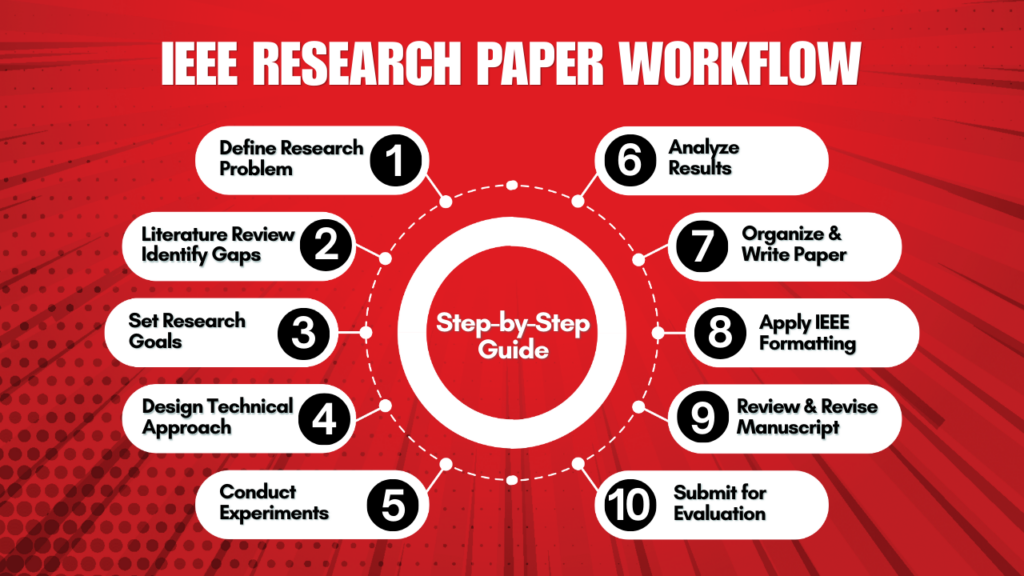
A Practical IEEE Research Paper Workflow for Developing Your Study
1. Develop a Well-Defined Research Problem
The foundation of every strong research paper begins with a clearly defined problem. Instead of starting with a vague concept, researchers should focus on identifying a specific challenge that requires investigation or improvement.
Research problems often emerge from:
- Observations during academic projects
- Technical limitations discovered in previous studies
- Industrial requirements or emerging technologies
- Experimental issues encountered during research work
Before proceeding, it is helpful to clarify the research focus by answering a few questions:
- What issue does this study attempt to address?
- Why is this problem relevant in the current technological context?
- What improvements can this research introduce?
Summarizing the research concept in a few concise sentences helps define the direction of the entire study.
2. Examine Existing Studies and Identify Research Gaps
After defining the problem, the next stage involves reviewing previously published work. This process allows researchers to understand the current progress in the chosen field and identify areas where improvements are still needed.
As part of the IEEE research paper workflow, academic databases provide access to high-quality technical publications, including:
- IEEE Xplore Digital Library
- Google Scholar
- ScienceDirect
- SpringerLink
- ResearchGate
During the review process, researchers should examine:
- The problem addressed by earlier studies
- The technical methods or systems implemented
- The limitations or challenges reported in those works
Through careful comparison of existing studies, researchers can recognize a research gap—an area where existing solutions are insufficient or incomplete. This gap becomes the main motivation for the proposed study.
3. Establish Clear Research Goals
Once the research gap is recognized, defining clear research goals becomes essential. These goals describe what the study intends to accomplish.
Typical objectives in engineering research may include:
- Enhancing system efficiency or accuracy
- Reducing computational complexity
- Designing optimized algorithms or architectures
- Developing scalable or cost-efficient solutions
Clearly stated goals provide direction for the research process and help readers understand the purpose of the study.
4. Plan the Technical Approach
The next phase involves designing a technical strategy that explains how the problem will be addressed. This section forms the methodological backbone of the research paper.
Depending on the research domain, the approach may involve:
- Algorithm development
- Machine learning models
- Signal or image processing techniques
- Simulation-based evaluation
- Hardware or embedded system design
A typical experimental workflow in computational research may involve:
- Data acquisition or dataset preparation
- Data preprocessing and feature extraction
- Model or algorithm development
- Training or simulation execution
- Performance measurement and validation
Each step should be clearly documented so that other researchers can understand and replicate the work if necessary.
5. Perform Experiments and Collect Results
After designing the research approach, the next stage involves implementing the proposed solution and conducting experiments. Experimental validation is essential for demonstrating the effectiveness of the research contribution.
Activities in this stage may include:
- Programming algorithms or models
- Running simulations or computational experiments
- Testing system prototypes
- Measuring performance under different conditions
Researchers should record relevant performance indicators such as:
- Accuracy
- Precision or recall
- Computational efficiency
- Processing time
Comparing these outcomes with previously published techniques helps demonstrate the value of the proposed approach.
6. Evaluate Findings and Provide Insights
Raw experimental results alone do not fully communicate the significance of the research. Authors must interpret the findings and explain why the results matter.
Important aspects to address include:
- The reasons behind improved performance
- Conditions that influenced the results
- Limitations that remain unresolved
Visual elements such as graphs, charts, and comparative tables can help readers understand the results more effectively. A thoughtful analysis strengthens the credibility of the study and highlights the research contribution.
7. Organize the Paper According to IEEE Structure
Technical manuscripts submitted to IEEE venues follow a standardized format. Organizing the content within this structure ensures clarity and consistency.
A typical IEEE-style research paper includes the following components:
- Title
A concise statement summarizing the main focus of the study. - Abstract
A brief overview of the research problem, methodology, and major findings. - Keywords
Important terms that improve discoverability in digital libraries. - Introduction
Background information, motivation for the study, and the contribution of the research. - Related Work
Discussion of previously published studies relevant to the topic. - Methodology or Proposed Approach
Detailed explanation of the techniques, algorithms, or systems developed. - Results and Analysis
Presentation and interpretation of experimental outcomes. - Conclusion
Summary of findings and suggestions for future improvements. - References
Citations formatted according to IEEE referencing style.
Following this structure ensures that the paper meets academic communication standards.
8. Apply IEEE Formatting Requirements
Proper formatting is an essential part of manuscript preparation. IEEE provides official templates that define the layout and formatting requirements for submissions.
These templates standardize elements such as:
- Font style and size
- Two-column layout
- Section headings
- Reference formatting
Templates are available for both Microsoft Word and LaTeX, allowing authors to prepare manuscripts using their preferred platform.
Ensuring that figures, tables, and citations follow IEEE guidelines helps avoid delays during the editorial review stage.
9. Review and Refine the Manuscript
Before submitting the paper, it is important to perform a careful review of the entire document. Editing improves clarity, accuracy, and overall readability.
Researchers should verify:
- Grammar and sentence clarity
- Logical flow between sections
- Correct formatting of figures and tables
- Proper citation of references
Receiving feedback from supervisors or colleagues can also help identify areas that require improvement. A well-polished manuscript increases the likelihood of progressing successfully through the review process.
10. Submit the Manuscript for Evaluation
The final stage involves submitting the manuscript to an appropriate IEEE conference or journal. Most submissions are handled through online platforms designed to manage the review process efficiently.
Once submitted, the manuscript undergoes evaluation by subject experts. Reviewers assess the originality, methodology, technical quality, and overall contribution of the research.
Based on the evaluation, authors may receive feedback requesting revisions. Addressing reviewer comments carefully and improving the manuscript accordingly is a normal and essential part of academic publishing.
Frequently Asked Questions
1. How do I start my IEEE research paper?
Begin with a clear research problem and well-defined goals. A focused start ensures your study has direction and purpose.
2. Where can I find reliable research papers?
Use trusted databases like IEEE Xplore, Google Scholar, ScienceDirect, SpringerLink, or ResearchGate. These provide peer-reviewed studies to build your research on solid foundations.
3. How can I make my results meaningful?
Analyze your data carefully, interpret the findings, and compare with existing work. This demonstrates the significance and impact of your research.
4. Who can guide me in publishing a PhD paper in India?
Organizations like Kenfra Research offer mentoring and support for planning, writing, and submitting papers. They help ensure your research meets academic standards and gets published successfully.

Final Thoughts
Transforming a research concept into a structured IEEE‑style manuscript requires planning, careful experimentation, and clear presentation. By following an organized IEEE research paper workflow—from defining the research problem, reviewing existing literature, conducting experiments, interpreting results, to preparing the final manuscript—researchers can effectively communicate their contributions to the scientific community.
Many researchers benefit from professional support and guidance during this process. For example, organizations such as Kenfra Research, a PhD company in India, offer services and mentoring to help scholars navigate stages of research and publication, particularly at the PhD level.







Leave a Reply