

How Cloud Billing Software is Shaping the Future of Finance in 2026
Kenfra Research - Bavithra2026-03-03T16:50:09+05:30In 2026, businesses are changing the way they manage money. One of the biggest reasons for this change is cloud billing softwares. From small startups to large global companies, everyone is moving toward smarter and faster financial systems.
Cloud billing software is not just a tool for sending invoices. It is now the heart of modern finance operations. It helps businesses automate billing, manage subscriptions, track payments, reduce errors, and improve cash flow, all from one platform.
In this blog, we will explain how cloud billing software is shaping the future of finance in 2026, why it matters, and how businesses can benefit from it.
What Is Cloud Billing Software?
Cloud billing softwares are an online billing system that allows businesses to create invoices, manage payments, and handle subscriptions using the internet.
Unlike traditional billing systems that require installation on office computers, cloud-based billing software works online. This means:
- No heavy hardware required
- Access from anywhere
- Automatic updates
- Better data protection
- Easy integration with financial systems
Because it operates in the cloud, finance teams can manage billing in real time without being tied to one location.
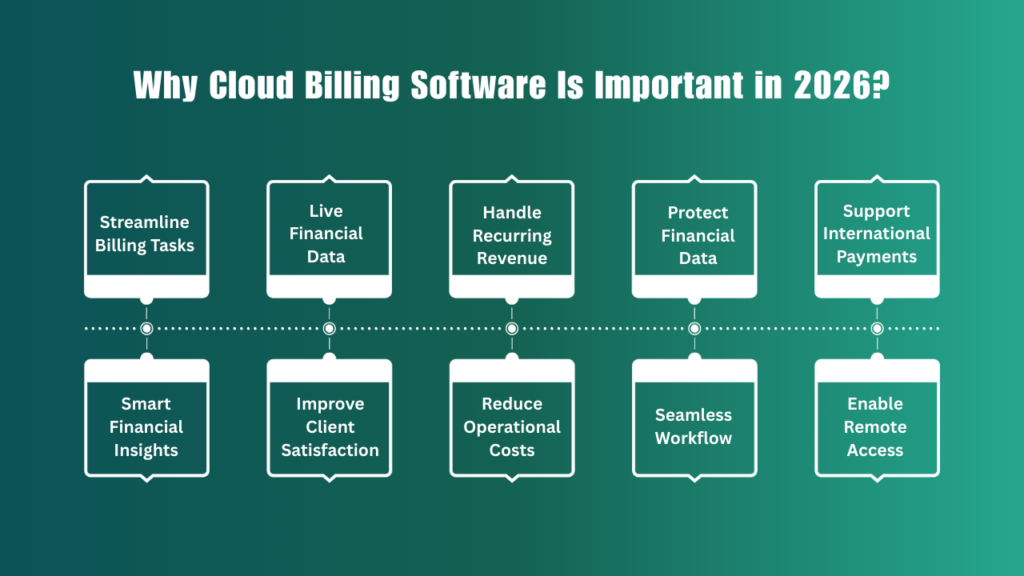
Why Cloud Billing Software Is Important in 2026?
In 2026, customers expect speed and convenience. They want instant invoices, flexible payment options, and smooth transactions. Manual billing systems cannot keep up with these expectations.
Cloud billing software helps businesses:
- Automate recurring billing
- Support subscription models
- Accept multiple payment options
- Reduce billing errors
- Generate instant financial reports
As a result, cloud billing software is becoming essential in modern finance departments.
1. Automation Is Transforming Financial Operations
One of the biggest advantages of billing software is automation. In the past, finance teams had to:
- Create invoices manually
- Track payments in spreadsheets
- Send reminders individually
- Calculate taxes by hand
This process was slow and error-prone.
In 2026, automation handles these tasks automatically. Cloud billing softwares can:
- Generate invoices instantly
- Apply taxes correctly
- Schedule recurring payments
- Send automatic reminders
This saves time and reduces human mistakes.
Automation allows finance teams to focus on strategy instead of paperwork.
2. Real-Time Financial Visibility
Modern businesses need real-time financial data. Cloud billing software provides live dashboards and instant reports.
With cloud-based billing systems, companies can:
- Track revenue in real time
- Monitor cash flow
- Identify overdue payments
- Forecast future income
This visibility helps business owners make faster and smarter decisions.
In 2026, data-driven finance is a major trend, and cloud billing software supports that shift.
3. Supporting Subscription-Based Business Models
Many businesses now operate on subscription or recurring revenue models. Cloud billing softwares make it easy to manage:
- Monthly subscriptions
- Annual plans
- Usage-based pricing
- Free trials
- Plan upgrades and downgrades
Managing subscriptions manually is complex. Cloud billing systems automate renewals and ensure customers are billed correctly.
This is one key reason why cloud billing software is shaping the future of finance.
4. Improved Security and Compliance
Financial data must be protected. Cloud billing software in 2026 includes advanced security features such as:
- Encrypted data storage
- Secure payment processing
- Automatic system updates
- Compliance with tax regulations
Because updates happen automatically, businesses stay compliant with changing tax rules without manual effort.
Security and compliance are major priorities in modern finance, and cloud billing systems address both.
5. Better Integration with Financial Systems
In today’s digital environment, different systems must work together. Cloud billing softwares can integrate with:
- Accounting systems
- Customer management platforms
- Enterprise resource planning systems
- Payment gateways
- Inventory tools
This reduces manual data entry and ensures accuracy.
Connected financial systems create a smooth workflow across departments.
6. Remote Access and Global Expansion
Remote work is common in 2026. Businesses operate across countries and time zones. Cloud billing software allows finance teams to:
- Access billing data from anywhere
- Handle multiple currencies
- Apply region-specific taxes
- Process international transactions
This flexibility supports global growth.
Traditional billing systems cannot provide this level of access and scalability.
7. Cost-Effective and Scalable
Cloud billing software is affordable for businesses of all sizes. Instead of investing in expensive infrastructure and IT maintenance, companies can use cloud solutions that operate online.
Benefits include:
- Lower upfront costs
- Flexible pricing models
- Easy scalability
- Reduced maintenance expenses
As a business grows, the billing system grows with it. Scalability is essential in 2026’s competitive market.
8. Artificial Intelligence and Smart Features
Artificial intelligence is becoming part of financial technology. Modern cloud billing software uses smart features to:
- Predict late payments
- Identify unusual transactions
- Analyze customer payment behavior
- Provide revenue forecasts
These intelligent insights help reduce risk and improve financial planning. AI-driven billing is shaping the future of finance.
9. Improved Customer Experience
Customers want easy and smooth billing experiences. Cloud billing software improves customer satisfaction by:
- Offering digital invoices
- Providing multiple payment options
- Sending timely reminders
- Allowing self-service billing portals
When billing is simple, customers are more likely to stay loyal. In 2026, customer experience and finance systems are closely connected.
10. Supporting Digital Transformation
Digital transformation is a major business trend in 2026. Cloud billing software supports digital transformation by:
- Reducing paperwork
- Eliminating manual processes
- Enabling online transactions
- Supporting remote operations
Finance departments are moving from traditional systems to digital platforms. Cloud billing software is a key driver of this shift.
Frequently Asked Questions
1. What is cloud billing software?
Cloud billing software is an online system that helps businesses automate invoicing, manage subscriptions, process payments, and generate financial reports through the cloud.
2. How does cloud billing software improve cash flow?
It improves cash flow by sending invoices on time, automating reminders, enabling faster payments, and reducing billing errors.
3. Why is cloud billing software important in 2026?
Cloud billing software is important because it supports automation, real-time reporting, global transactions, subscription models, and secure payment processing.
4. Is cloud billing software suitable for small businesses?
Yes. Cloud billing software is cost-effective, scalable, and easy to use, making it ideal for small and growing businesses.
5. Is cloud billing software secure?
Yes. Modern cloud billing systems use encryption, secure payment processing, and compliance updates to protect financial data.

Final Thoughts
In 2026, Cloud Billing Softwares are not optional—it is essential.
It helps businesses automate billing, manage subscriptions, support global payments, secure financial data, and gain real-time insights. With AI integration and digital payment systems growing rapidly, cloud-based billing solutions are shaping the future of finance.
In India, businesses looking for a reliable and modern solution are choosing Kenfra BillPad, one of the best billing software solutions in India. It offers smart invoicing, GST-ready billing, real-time reporting, and secure cloud access making it ideal for startups, retailers, wholesalers, and growing enterprises.








Leave a Reply