
Is a Web-Based CRM Right for You? Key Things to Consider
Kenfra Research - Bavithra2026-02-26T17:12:29+05:30In a digital-first business environment, customer relationships are the foundation of long-term success. Whether you run a startup, a growing small business, or a large organization, managing leads, sales pipelines, and customer interactions efficiently is critical. One of the most common questions business owners ask today is: Is a web-based CRM right for my business?
This in-depth guide will help you understand what a web-based CRM is, its advantages and disadvantages, and the key factors you should evaluate before making a decision.
What Is a Web-Based CRM?
A web-based CRM (Customer Relationship Management system) is a cloud-hosted software solution that allows businesses to manage customer data, sales activities, marketing campaigns, and support interactions through an internet browser.
Unlike traditional on-premise CRM systems that require installation on local servers, web-based CRM platforms are hosted in the cloud. This means:
- No physical server setup
- No manual software updates
- Access from anywhere with an internet connection
Simply put, a web-based CRM is an online system that stores and organizes your customer information securely in the cloud.
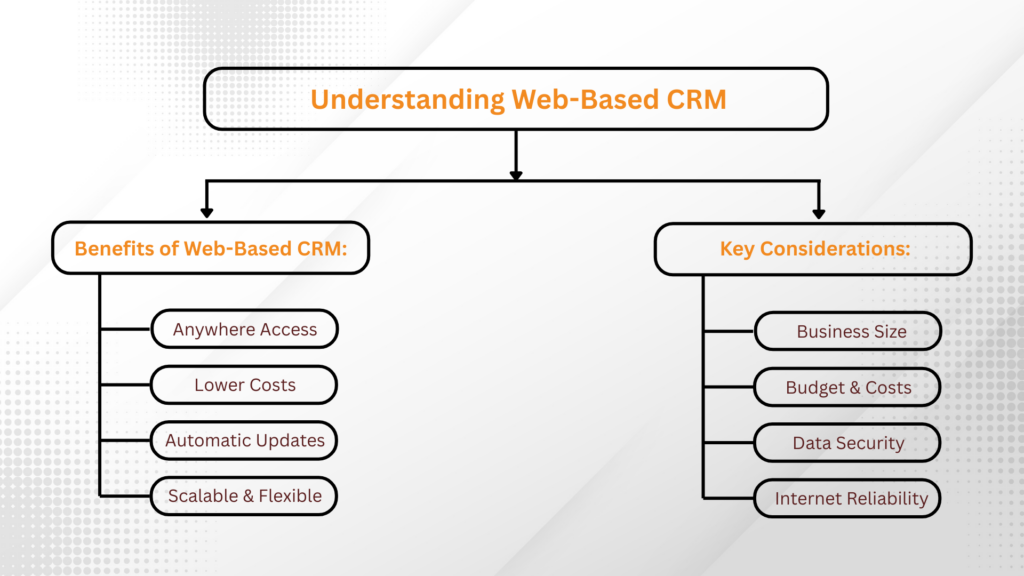
Why Are Businesses Choosing Web-Based CRM Systems?
Over the last decade, cloud technology has transformed business operations. Companies increasingly prefer web-based solutions due to their flexibility and cost-efficiency.
Here are the primary reasons businesses switch to web-based CRM systems:
1. Anywhere, Anytime Access
With remote work and hybrid teams becoming standard, accessibility matters. A web-based CRM allows:
- Sales teams to update deals on the go
- Managers to track performance in real time
- Support teams to respond quickly to customer queries
All you need is an internet connection.
2. Lower Initial Investment
Traditional CRM systems often require:
- Dedicated servers
- IT infrastructure
- Installation and setup costs
Web-based CRM solutions typically operate on a subscription model. This significantly reduces upfront investment and makes budgeting more predictable.
For startups and small businesses, this can be a major advantage.
3. Automatic Updates and Maintenance
With cloud-based crm systems, the service provider handles:
- Software updates
- Security patches
- Performance improvements
You don’t need an in-house IT team to manage system maintenance.
4. Scalability as You Grow
Business growth demands flexible tools. A web-based CRM allows you to:
- Add new users easily
- Upgrade features
- Expand storage capacity
You can scale up (or down) based on your business needs without purchasing new hardware.
Key Things to Consider Before Choosing a Web-Based CRM
While web-based CRM systems offer many benefits, they are not a one-size-fits-all solution. Consider the following factors carefully.
1. Your Business Size and Growth Goals
The first step is evaluating your current and future needs.
Ask yourself:
- How many users will need access?
- Do you need advanced automation?
- Will your customer base grow significantly in the next few years?
A small business may only need contact management and basic reporting, while a larger organization may require automation, advanced analytics, and customization capabilities.
Choose a system that aligns with both your current operations and long-term strategy.
2. Budget and Total Cost of Ownership
Although web-based CRM platforms reduce upfront costs, you must evaluate long-term expenses.
Consider:
- Monthly or annual subscription fees
- Per-user pricing models
- Add-on feature costs
- Data storage limitations
- Integration fees
Calculate the projected cost over 3–5 years instead of focusing only on the starting price.
3. Data Security and Compliance
Since your customer data is stored online, security is a critical factor.
Important questions to ask:
- Is data encrypted in transit and at rest?
- Does the provider comply with relevant data protection regulations?
- Are regular security audits conducted?
- Is role-based access control available?
If you operate in regulated industries such as finance or healthcare, compliance requirements should be a top priority.
4. Internet Dependency
A web-based CRM relies entirely on internet connectivity.
Consider:
- Do you have reliable internet access?
- Does your team work in areas with unstable connections?
If internet outages are common in your region, this could affect productivity.
5. Integration with Existing Tools
Your CRM should seamlessly connect with other business systems such as:
- Email platforms
- Marketing tools
- Accounting software
- E-commerce systems
- Customer support platforms
Strong integration capabilities ensure smooth workflows and eliminate data silos.
6. Ease of Use and Team Adoption
A CRM system is only effective if your team actually uses it.
Look for:
- Intuitive dashboards
- Simple navigation
- Minimal training requirements
- Good onboarding support
Before committing, request a demo or trial to test usability.
7. Customization and Automation
Every business has unique processes. A flexible web-based CRM should allow:
- Custom fields
- Workflow automation
- Sales pipeline customization
- Reporting dashboards tailored to your KPIs
Automation can reduce repetitive tasks and improve operational efficiency.
Web-Based CRM vs On-Premise CRM
For many modern businesses, the flexibility of cloud-based crm solutions makes them the preferred choice.
Frequently Asked Questions
1. Is a web-based CRM secure?
Yes, most web-based CRM systems use encryption and secure data centers. However, you should verify compliance standards and security certifications before choosing a provider.
2. Is a web-based CRM suitable for small businesses?
Yes. Web-based CRM systems are particularly suitable for small businesses because they require lower upfront investment and minimal IT infrastructure.
3. What is the main disadvantage of a web-based CRM?
The primary drawback is dependence on internet connectivity. Without a stable connection, access to the system may be limited.
4. Can a web-based CRM scale with my business?
Yes. Most cloud-based CRM systems are designed to grow with your business by allowing additional users, features, and storage.

Conclusion: Is a Web-Based CRM Right for You?
For most modern businesses, the answer is yes.
If you value flexibility, mobility, scalability, and lower upfront costs, a web-based CRM is likely the right solution for your business. A cloud-hosted CRM empowers your team to collaborate efficiently, track customer interactions accurately, and improve overall productivity — all without heavy investment in IT infrastructure. For example, many businesses today choose Kenfra CRM as their web-based customer management platform because it combines ease of use with powerful tools for sales, marketing, and support in a single online system.









Leave a Reply