
Is iThenticate the Same as Turnitin? A Clear Explanation for PhD Researchers
Kenfra Research - Bavithra2026-02-06T17:23:23+05:30Plagiarism checking is a serious part of academic life, especially for PhD researchers. Before submitting a thesis, research paper, or journal article, most universities ask for a plagiarism report. At this stage, many researchers get confused and ask: Are iThenticate and Turnitin the same?
This confusion is common because both tools are owned by the same company and both are used to check plagiarism. However, they are not identical, and using the wrong one can sometimes cause problems during thesis submission or journal publication.
This blog explains everything in simple words so you can clearly understand how these tools work, how they are different, and which one is right for your PhD journey.
Understanding Plagiarism Detection Tools in Academic Research
Plagiarism detection tools compare your writing with millions of documents to find text similarities. These documents include published research papers, books, websites, student papers, and journals.
Universities, publishers, and supervisors use plagiarism reports to check originality. For PhD researchers, originality is critical because journals and institutions have strict plagiarism limits.
Many scholars ask questions like is ithenticate and turnitin same or does turnitin and ithenticate are similar. The confusion is understandable because both tools are owned by the same company and work in a similar way on the surface. However, their purpose and usage are different.
What Is Turnitin?
Turnitin is a plagiarism detection tool mostly used in educational institutions. Universities use it to check:
- Assignments
- Term papers
- Coursework
- Student projects
Turnitin compares submitted work against:
- Student papers submitted earlier
- Internet content
- Books and journals
- Institutional databases
It also provides similarity scores, highlighted matches, and instructor feedback features.
Turnitin is very popular among undergraduate and postgraduate students. Many PhD students also encounter it during coursework or internal evaluations.
What Is iThenticate?
iThenticate is a plagiarism detection tool designed mainly for researchers, publishers, and academic journals. It checks documents against:
- High-quality academic journals
- Conference proceedings
- Scientific publications
- Professional research databases
Most Scopus-indexed and Web of Science journals use iThenticate before accepting research papers.
Unlike Turnitin, iThenticate is not focused on classroom assignments. It is focused on research integrity and publication-level checks.
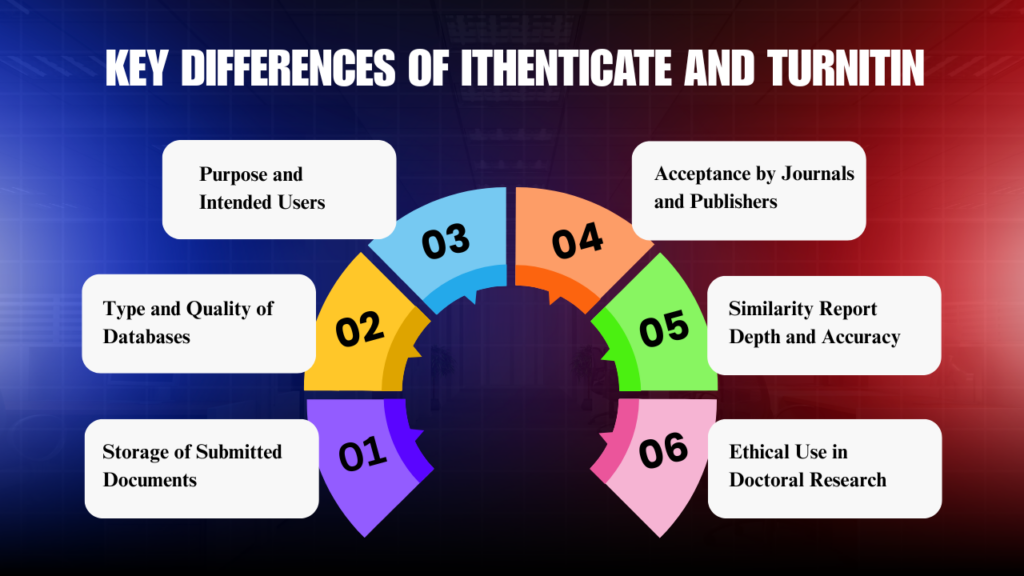
Key Differences of iThenticate and Turnitin Every PhD Researcher Must Know
For PhD researchers, understanding plagiarism tools is not optional—it is essential. Many scholars mistakenly believe both tools work the same way, but knowing the difference between ithenticate and turnitin can protect your research from rejection, ethical issues, and publication delays. Below are the most important differences every PhD researcher must clearly understand.
1. Purpose and Intended Users
The biggest difference lies in who these tools are made for. Turnitin is designed mainly for students and teachers. It is commonly used to check assignments, coursework, essays, and basic dissertations. Universities use it to teach students about plagiarism and academic writing. iThenticate, on the other hand, is built for researchers, scholars, and publishers. It is the standard tool used by:
- Academic journals
- Research institutions
- PhD supervisors
- Publishers
This is why many people ask does turnitin and ithenticate are similar. While they check text similarity, their academic purpose is very different.
2. Type and Quality of Databases
Another major difference between ithenticate and turnitin is the database they use for comparison.
Turnitin compares your work with:
- Student assignments
- Internet sources
- Institutional repositories
This works well for student-level writing but is not sufficient for advanced research.
iThenticate compares your work with:
- High-impact journals
- Peer-reviewed articles
- Conference proceedings
- Books and scholarly publications
For PhD research, this deeper academic database is critical. Journals trust iThenticate reports because they reflect real research-level similarity.
3. Storage of Submitted Documents
This is one of the most dangerous differences for PhD researchers.
Turnitin usually stores submitted papers in its student database. This means:
- Your work may appear as a previous submission later
- Journals may detect self-plagiarism
- Your manuscript could be rejected
iThenticate does not store your document unless requested by a publisher. This protects the originality of your research.
Many scholars wondering is ithenticate and turnitin same are unaware of this risk. For PhD researchers, storage policy alone makes iThenticate the safer choice.
4. Acceptance by Journals and Publishers
Most academic journals do not accept Turnitin reports for research papers. They expect plagiarism checks using iThenticate.
This creates a clear difference between turnitin and ithenticate plagiarism report:
- Turnitin reports are student-focused
- iThenticate reports are publication-ready
Editors and reviewers trust iThenticate because it aligns with publishing standards. Using the wrong tool can delay or block publication.
5. Similarity Report Depth and Accuracy
Although both tools provide similarity percentages, their reports are not equal.
Turnitin reports often include:
- Matches from student work
- General internet content
- Educational formatting similarities
iThenticate reports are more refined and show:
- Exact journal matches
- Proper citation overlaps
- Research-level text reuse
This answers the question ithenticate and turnitin same—they may look similar visually, but the analysis depth is very different.
6. Ethical Use in Doctoral Research
PhD research demands original contribution to knowledge. Using a student-focused tool can raise ethical concerns.
Universities often instruct PhD scholars to use iThenticate only, precisely because of the difference between ithenticate and turnitin in academic integrity standards.
If your research is meant for:
- Thesis submission
- Journal publication
- Conference presentation
iThenticate is the ethically correct tool.
Freuqently Asked Questions
1. Are iThenticate and Turnitin the same tool?
No, they are not the same. While both tools are owned by the same company and check text similarity, Turnitin is designed for students and classroom assignments, whereas iThenticate is meant for researchers and publishers to check academic papers and journal submissions.
2. Which plagiarism tool should I use for my PhD thesis?
For PhD research, iThenticate is recommended because it compares your work against scholarly journals, conference papers, and professional research databases. Turnitin is more suitable for coursework or student assignments.
3. Can I use Turnitin for journal publication?
Most journals do not accept Turnitin reports. Journals prefer iThenticate reports since they focus on research-level content and are considered publication-ready.
4. Do iThenticate and Turnitin provide the same similarity reports?
No. Turnitin’s report is student-focused and may include internet sources or student papers, while iThenticate’s report is more detailed, highlighting exact matches with journals, scholarly articles, and properly cited work.
5. Does Kenfra Research offer support for journal publication besides plagiarism checks?
Yes. Kenfra Research assists with the entire publication process, including manuscript formatting, journal selection, submission guidance, and plagiarism-free report preparation to improve the chances of acceptance.

Conclusion
For PhD researchers, plagiarism checking is not just a formality—it is a critical step that reflects the quality and originality of their research. Understanding how plagiarism tools work helps researchers make the right choices and avoid unnecessary problems during thesis submission or journal publication.
While both tools are popular, they serve different purposes, and using the correct one at the right stage is essential for academic success. Support from experienced research organizations like kenfra research can make this journey smoother. With proper PhD research guidance in India, scholars receive clarity, direction, and expert support that helps them focus on what truly matters—producing original, high-quality research.






Leave a Reply