
List of Scopus and Web of Science Indexed Journals 2026 [Updated Guide]
Kenfra Research - Bavithra2026-03-04T17:15:30+05:30Publishing your research in Scopus and Web of Science Indexed Journals is a major milestone for students, researchers, and academics. These indexed journals are considered reputable and recognized worldwide, making them great choices for boosting visibility and strengthening your academic profile.
In this guide, we’ll explain what Scopus and Web of Science Indexed Journals are, why Scopus and Web of Science matter in 2026, and how to find up-to-date lists of indexed journals. We’ll also share tips on how to choose the right journal for your research.
What Are Indexed Journals?
Indexed journals are scientific journals that meet strict quality standards and are included in large academic databases. These databases are used by universities and libraries around the world.
When a journal is indexed, it means:
- It has passed quality checks.
- Articles published in it are easier to find and cite.
- Research becomes more visible to other scholars.
Two of the most trusted indexes are Scopus and Web of Science.
Scopus and Web of Science Indexed Journals 2026
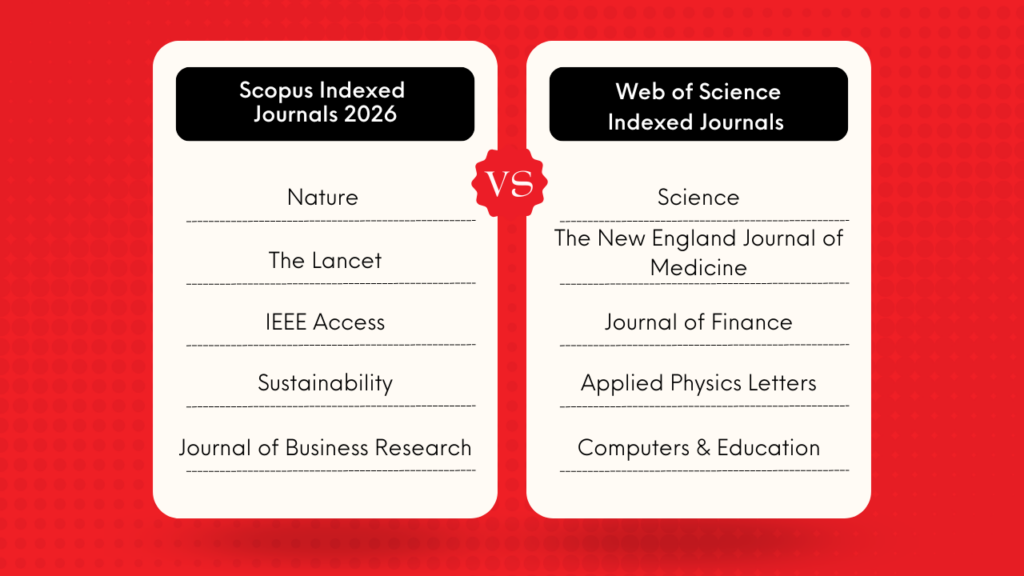
5 Main Scopus Indexed Journals (2026)
Below are five well-known and respected journals indexed in Scopus. These journals are popular globally and cover different subject areas.
1. Nature
- Publisher: Springer Nature
- Field: Multidisciplinary Science
- Impact: Very high
- Type: Research and review articles
One of the world’s most prestigious journals is Nature. It publishes groundbreaking research in science and technology. Acceptance rate is very low, and competition is strong.
Best for: Advanced and innovative research.
2. The Lancet
- Publisher: Elsevier
- Field: Medicine and Health Sciences
- Impact: Extremely high
- Type: Clinical and medical research
The Lancet is a top medical journal. It publishes research related to global health, diseases, public health policies, and clinical trials.
Best for: Medical researchers and healthcare professionals.
3. IEEE Access
- Publisher: IEEE
- Field: Engineering and Technology
- Type: Open Access
- Review time: Relatively fast
IEEE Access is popular among engineering and computer science researchers. It covers a wide range of technical subjects and is fully open access.
Best for: Engineering, AI, IoT, computer science topics.
4. Sustainability
- Publisher: MDPI
- Field: Environmental and Sustainability Studies
- Type: Open Access
Sustainability publishes research related to environmental science, sustainable development, climate change, and green technologies.
Best for: Environmental science and policy research.
5. Journal of Business Research
- Publisher: Elsevier
- Field: Business and Management
- Impact: Strong
This journal focuses on business strategy, marketing, entrepreneurship, and organizational behavior.
Best for: Business scholars and management researchers.
How to Choose the Right Journal in 2026
Choosing the right journal is crucial for your research. A good journal increases acceptance chances, visibility, and credibility. Here’s a short and simple guide:
1. Check Indexing Status
Verify if the journal is listed in Scopus or Web of Science using official databases. Indexing can change, so don’t rely on claims from the journal website.
2. Match Your Topic
Ensure your research fits the journal’s scope. Check recent papers to see if your work aligns with what they publish.
3. Consider Metrics
Look at Impact Factor (WoS) or CiteScore (Scopus) for reputation. Relevance matters more than just high numbers.
4. Review Time & Fees
Check the journal’s average review time and any publication fees (APC). Faster review helps meet deadlines.
5. Avoid Predatory Journals
Be careful of journals that promise quick acceptance or fake indexing. Verify indexing through official Scopus or WoS lists.
6. Editorial Board & Guidelines
Look for a strong editorial board and follow author guidelines carefully to avoid desk rejection.
Tip: The best journal is one that matches your topic, is indexed officially, and has transparent policies. Proper selection saves time and strengthens your research impact.
5 Main Web of Science Indexed Journals (2026)
Now let’s look at five respected journals indexed in Web of Science.
1. Science
- Publisher: AAAS
- Field: Multidisciplinary Science
- Impact: Extremely high
Science is one of the most respected journals globally. It publishes original scientific research across many disciplines.
Best for: High-impact scientific discoveries.
2. The New England Journal of Medicine
- Publisher: Massachusetts Medical Society
- Field: Medicine
- Impact: Among the highest in medicine
This journal is highly trusted in the medical community. It publishes clinical research and medical breakthroughs.
Best for: Clinical and medical researchers.
3. Journal of Finance
- Publisher: Wiley
- Field: Finance and Economics
- Impact: Very high in finance
The Journal of Finance is a leading journal in financial research. It publishes theoretical and empirical studies.
Best for: Finance and economics scholars.
4. Applied Physics Letters
- Publisher: AIP Publishing
- Field: Applied Physics
This journal publishes short and impactful research in applied physics and materials science.
Best for: Physics and engineering researchers.
5. Computers & Education
- Publisher: Elsevier
- Field: Educational Technology
Computers & Education focuses on digital learning, AI in education, and educational innovation.
Best for: Researchers in education and technology integration.

Frequently Asked Questions
1. Which journals are indexed in Scopus?
Scopus lists thousands of journals in science, medicine, engineering, business, and social sciences. Examples: Nature, The Lancet, IEEE Access, Sustainability, Journal of Business Research.
2. What is Scopus Q1, Q2, Q3, Q4?
Scopus ranks journals into four quartiles based on citations:
Q1: Top 25% (best journals)
Q2: 25–50%
Q3: 50–75%
Q4: Bottom 25%
3. What is better, Scopus or Web of Science?
Scopus: More journals, broader coverage.
Web of Science: Stricter, high-quality journals.
Both are trusted.
4. Is Scopus Q1 good?
Yes! Q1 journals are considered high-quality journals. Publishing in a Q1 journal increases your research visibility, credibility, and chances for academic recognition.
5. Which Scopus journals publish fast?
Some fast-publishing journals: IEEE Access, Sustainability, PLoS ONE, Heliyon. Usually take 3–6 months.
Conclusion
Publishing in a Scopus and Web of Science indexed journals in 2026 is a smart step for students, researchers, and academics who want their work to be recognized globally. Indexed journals improve the visibility of your research, strengthen your academic profile, and ensure your work reaches the right audience.
For researchers in India looking for guidance, professional consultancies like Kenfra Research the best PhD research consultancies can provide support in selecting the right journals, preparing manuscripts, and navigating the publication process. Their expert advice can save time, reduce errors, and help you publish in high-quality, indexed journals efficiently.









Leave a Reply