

Problem Statement vs Research Gap: What Most Scholars Get Wrong
Kenfra Research - Bavithra2026-02-02T17:08:03+05:30Many students and early-career researchers struggle with one common issue: confusing the problem statement with the research gap. This confusion often leads to weak proposals, rejected theses, and unclear research objectives. Although both terms are closely related, they are not the same. Understanding the difference between a problem statement vs research gap is critical for writing high-quality academic research. In this blog, we’ll break down the difference in simple words, explain what most scholars get wrong, and show you how to clearly identify both—without overcomplicating things.
Why This Confusion Matters More Than You Think?
Examiners, reviewers, and supervisors look very closely at clarity. A poorly defined research problem or an unclear gap in existing studies signals weak research thinking. Many low-quality papers fail not because the topic is bad, but because the author cannot clearly explain what is wrong and what is missing. Search intent data also shows that students actively look for explanations like “what is a research gap,” “how to write a problem statement,” and “difference between problem statement and research gap in research methodology.” That alone shows how widespread the confusion is.
What a Problem Statement Really Is?
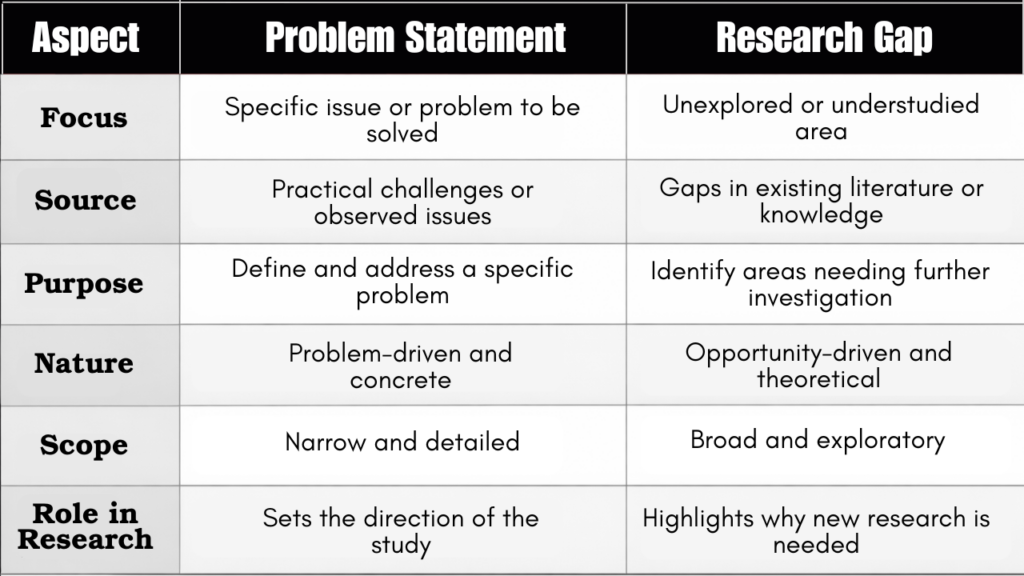
A problem statement explains what specific issue exists in the real world or academic field that needs attention. It focuses on a difficulty, challenge, or undesirable situation that requires investigation.
In simple terms:
- It describes what is wrong
- It explains who is affected
- It shows why the problem matters
A good problem statement does not talk about missing studies or literature gaps directly. Instead, it focuses on a concrete issue that can be observed, measured, or experienced. Understanding the difference between a problem statement vs research gap helps researchers avoid confusing a real-world issue with what is simply missing in the literature.
For example, in education research, a problem statement may explain declining student engagement in online classrooms. In healthcare research, it might focus on delayed diagnosis in rural hospitals. In business research, it could highlight poor employee retention despite high salaries. Many scholars mistakenly turn their problem statement into a literature summary. This is one of the most common errors. A problem statement should be grounded in reality first, not just in past research.
What a Research Gap Actually Means?
A research gap refers to what existing research has not yet explored, explained, or resolved. It comes from reviewing previous studies, theories, and findings.
In other words:
- It explains what is missing in current knowledge
- It shows limitations of past studies
- It justifies why new research is needed
When people search for research gap vs problem statement, they are usually trying to understand why supervisors insist on having both. The reason is simple: the research gap connects your study to academic literature, while the problem statement connects it to real-world or theoretical issues.
A research gap might appear because:
- Past studies used outdated data
- Certain populations were ignored
- Results were contradictory
- Methods were limited
- Contexts were too narrow
Unlike the problem statement, a research gap cannot exist without a literature review.
Where Most Scholars Get It Wrong?
The biggest mistake scholars make is reversing the roles. Many students write a paragraph explaining that “few studies have examined X” and label it as a problem statement. That is not a problem statement; that is a research gap. Others describe a real-world issue but call it a research gap without referencing any existing studies. That weakens the academic foundation of the work. Another common issue is merging both ideas into one unclear paragraph. This makes it difficult for readers to understand what exactly the study is solving and what it is adding to existing knowledge. If you are writing a thesis or dissertation, this confusion can lead to major revisions or even rejection.
Problem Statement vs Research Gap: Core Differences
Frequently Asked Questions
1. What is the difference between a problem statement and a research gap?
The difference between a problem statement and a research gap lies in their focus. A problem statement explains a real-world or academic issue that needs attention, while a research gap explains what existing research has not fully explored or answered.
2. What services does Kenfra Research offer?
Kenfra Research is a leading PhD research consultancy in India, offering end-to-end PhD support including topic selection, problem statement and research gap formulation, proposal and thesis writing, literature review, data analysis (SIMULINK, PYTHON, MATLAB, VERILOG, GAMS, HFSS, FLUTTER, FIGMA, NS3, CLOUDSIM, SPSS, and more), and journal publication guidance.
3. How does research gap vs problem statement work in academic research?
In academic research, the problem statement comes from observing a real issue, while the research gap is identified after reviewing existing literature. The research gap vs problem statement relationship helps researchers justify why a new study is necessary and how it adds value to existing knowledge.
4. Can a research gap exist without a problem statement?
No, a research gap cannot exist without a clearly defined problem statement. The research gap is always connected to a problem because it highlights what existing research has failed to address about that problem. Without a problem statement, the research gap lacks direction and purpose.
5. Is a research gap part of the literature review?
Yes, a research gap is identified through a literature review. By analyzing previous studies, theories, and findings, researchers discover limitations, unanswered questions, or missing perspectives. This process helps clearly explain the research gap in research and supports the need for further investigation.
6. How can Kenfra Research help with PhD assistance in India?
Kenfra Research offers complete PhD assistance in India, including guidance on topic selection, research design, methodology, and dissertation writing. Scholars from Nagercoil, Marthandam, Andhra Pradesh, and other locations can get both online and offline support tailored to their needs.

Final Thoughts
Understanding the difference between a problem statement and a research gap is more than academic theory—it is a practical research skill. A clear problem statement highlights the real-world or academic issue, while a research gap shows what existing studies have missed. Together, they make your research proposal stronger, improve acceptance chances, and clearly show your contribution to knowledge.
For scholars looking for professional guidance, Kenfra Research, a leading PhD research consultancy in India, provides expert support in thesis writing, research proposals, literature review, and journal publications.







Leave a Reply