

Ready for Your Computer Science PhD Viva? Start with These Questions
Kenfra Research - Bavithra2026-02-20T17:34:16+05:30Preparing for a Computer Science PhD viva voce can be stressful, but knowing what to expect makes a huge difference. Your viva voce, also called a thesis defense, is where you present your research and answer questions from examiners. To succeed, you need to anticipate the questions and prepare clear, confident answers.
This guide lists the most common Computer Science PhD viva voce questions first, followed by tips and preparation strategies to help you excel.
Computer Science PhD Viva Voce Questions:
Core Research and Contributions
During your viva, examiners often focus on your core research contributions. They want to see that you can write your thesis clearly, highlight its novelty, and explain its relevance. Typical questions in this area include:
- Can you briefly summarize the main idea of your thesis in one or two sentences?
- What is the original contribution of your research? For example, did you develop a new algorithm, framework, or model?
- Why is the problem you addressed important—practically, theoretically, or industrially?
- What motivated you to pursue this research, and how did you identify the research gap?
- How has working on this topic changed your perspective or understanding of the field?
These questions are designed to test your ability to communicate your research clearly and to ensure you understand the broader impact of your work.
Methodology and Technical Decisions
Examiners in a Computer Science PhD viva voce often dig into your methodological choices and technical reasoning. They want to know that your approach was well-thought-out and justified. Common PhD viva voce questions include:
- Why did you select this specific research methodology (e.g., experiments, prototyping, simulations)?
- Were there other methods you considered, and why did you decide against them?
- How did you deal with limitations or constraints in your approach?
- How can you be confident that your findings are correct and reliable?
- Does your system, algorithm, or model scale effectively from small test cases to real-world data?
Answering these PhD viva voce questions shows examiners that you thought critically about your approach and can defend your choices against alternatives.
Literature and Context Questions
Your understanding of the broader field is crucial in a viva. Examiners may ask:
- Who are the leading researchers or “key players” in your area, and how does your work relate to theirs?
- Which published studies are most relevant to your research, and why?
- What work is closest to yours, and how does your research differ or improve upon it?
These questions assess your knowledge of the state-of-the-art and your ability to situate your work within existing research.
Evaluation and Future Directions
Finally, examiners in a Computer Science PhD viva voce want to see your critical thinking and vision for future research. Common PhD viva voce questions in this area include:
- What do you consider the strongest and weakest aspects of your research?
- If you had another year to work on this project, what would you do differently?
- What future directions or extensions could build upon your research?
Being able to reflect on your work honestly and suggest meaningful extensions demonstrates maturity as a researcher and shows examiners that you can think beyond your thesis.
Top 15 Most Common PhD Viva Questions
- What is the main contribution of your thesis?
- What problem does your research solve?
- Why is this problem important?
- What research gap did you identify?
- How is your work different from existing approaches?
- Can you summarize your thesis in 3–5 minutes?
- Why did you choose this methodology?
- What are the key assumptions in your work?
- What are the limitations of your research?
- How did you validate or evaluate your results?
- Why did you choose these evaluation metrics?
- What is the computational complexity of your algorithm/system?
- How is your approach better than the state-of-the-art?
- What future work can extend your research?
- Why should this thesis be awarded a PhD?
How to Prepare for Your Computer Science PhD Viva?
Proper preparation can reduce anxiety and boost confidence. One of the first steps is to familiarize yourself with the types of PhD viva voce questions you may be asked and learn how to prepare for the PhD viva voce.
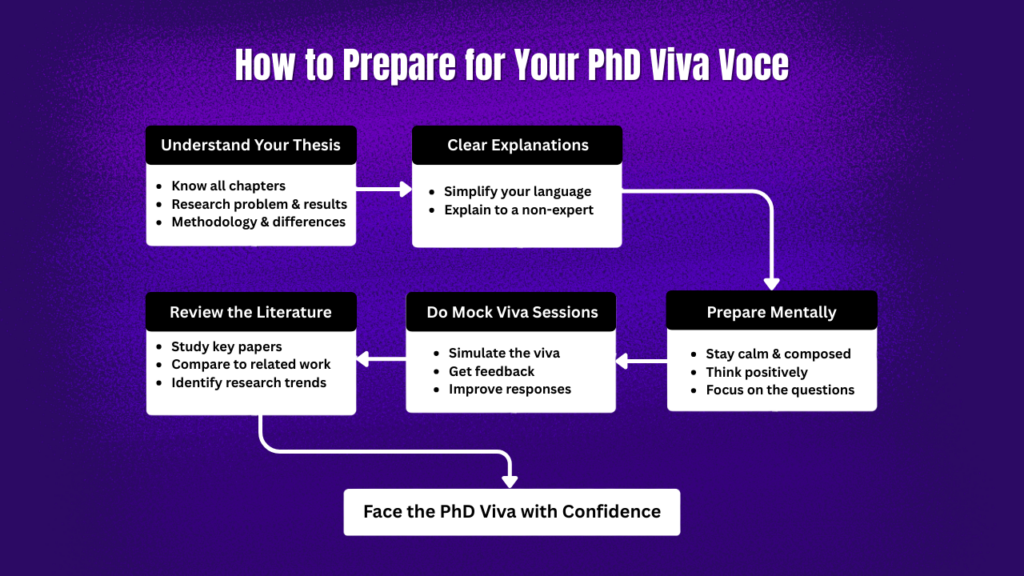
1. Understand Your Thesis Completely
Know every chapter of your thesis. Be ready to explain:
- Research problem and its significance
- Methodology and data analysis
- Key results and contributions
- Differences from previous studies
A summary sheet can help you review quickly.
2. Review Literature Thoroughly
Examiners often ask about related studies. Be prepared to:
- Name influential papers and authors
- Explain how your research builds on or differs from existing work
- Discuss trends in your area (AI, cybersecurity, data science, etc.)
3. Practice Clear Explanations
Even for experts, clarity matters. Practice explaining your research in simple language. Explain your work to someone outside your field to ensure it’s understandable.
4. Do Mock Viva Sessions
Simulate the real viva:
- Ask your supervisor or peers to act as examiners
- Time your answers and record them
- Identify weak areas and improve your responses
5. Prepare Mentally
A positive mindset is crucial:
- Treat questions as opportunities, not tests
- Stay composed under pressure
- Speak clearly and logically
Frequently Asked Questions (FAQs) About PhD Viva
1. How do I prepare for my PhD viva?
Prepare by thoroughly reviewing your thesis, revising core concepts, conducting mock viva sessions, preparing clear slides, and practicing concise answers. Focus on explaining your research clearly and anticipating questions on methodology, results, and limitations.
2. Which is the best topic for PhD in computer science?
The best topic depends on your interests, the research gap, and practical relevance. Popular areas include artificial intelligence, machine learning, cybersecurity, data science, IoT, cloud computing, and human-computer interaction. Choose a topic that is original and has long-term research potential.
3. What questions will be asked in viva?
Examiners typically ask about:
- Thesis summary and core contributions
- Research methodology and technical decisions
- Comparison with related work
- Limitations and future research
- Practical and theoretical significance of your work
4. What is the final viva of PhD?
The final PhD viva is the oral defense of your thesis in front of examiners. It is the last step before being awarded your degree, where you present your research, answer questions, and demonstrate your expertise and originality.

Conclusion
Preparing for these core research, methodology, and contribution questions is essential to succeed in your Computer Science PhD viva voce. Focus on clarity, critical thinking, and honest self-reflection. Common PhD viva voce questions you should be ready for include:
- What motivated your research, and why is it significant?
- Why did you choose this specific methodology, and how did you handle limitations?
- How do your results compare with existing studies?
- What are the strongest and weakest aspects of your research?
- What future directions or extensions do you see for your work?
By practicing your answers and understanding your thesis deeply, you can face any examiner question with confidence. For expert guidance, mock viva sessions, thesis review, and full PhD support, Kenfra Research offers comprehensive PhD viva voce support and guidance tailored to Computer Science candidates.








Leave a Reply