

Software defined Vehicular Networks PhD Assistance
KENFRA Research Solutions2026-03-17T13:11:34+05:30Vehicular networks combined with Software Defined Networking (SDN) help manage communication between vehicles more efficiently. This integration improves network performance by increasing scalability, throughput, and the data delivery ratio.
This blog briefly explains the concept of Software Defined Networking and how it works with vehicular networks. It also highlights a few important research topics in this area.
What is Software Defined Network?
Software Defined Network (SDN) is a networking approach that separates the control of the network from the hardware devices. In traditional networks, control and data forwarding happen in the same device. In SDN, these functions are separated.
The network is controlled by a centralized controller that has a global view of the entire network. Switches and other devices follow the instructions provided by this controller. Because of this centralized control, SDN can adapt easily to changing network conditions and manage bandwidth more efficiently.
Why Integrate SDN with Vehicular Networks?
Communication between vehicles is an important part of Intelligent Transportation Systems (ITS). Vehicles exchange information for both safety and non-safety purposes, such as accident alerts, traffic updates, and infotainment services.
In a vehicular network, communication can occur between:
- Vehicle to Vehicle (V2V)
- Vehicle to Infrastructure (V2I)
- Vehicle to Network (V2N)
- Vehicle to Pedestrian (V2P)
Vehicles move quickly and frequently change their network connections. Because of this dynamic environment, managing communication becomes difficult with traditional networking methods. Integrating SDN helps by providing centralized control and flexible network management, which improves data transmission efficiency.
Research Topics in Software-Defined Vehicular Networks
Software-Defined Vehicular Networks (SDVN) is an active research area with many possible directions. Researchers often focus on improving specific parameters such as latency, security, or resource management.
Some common research topics include:
- Dynamic controller placement strategies
- Blockchain-based distributed SDVN
- Optimization of the control plane
- Security mechanisms for SDVN
- Data offloading in vehicle-to-vehicle communication
- Resource scheduling and management
- Low-latency communication in SDVN
These research topics can be further extended by applying new algorithms, optimization methods, or emerging technologies to improve overall network performance.
SDVN Architecture
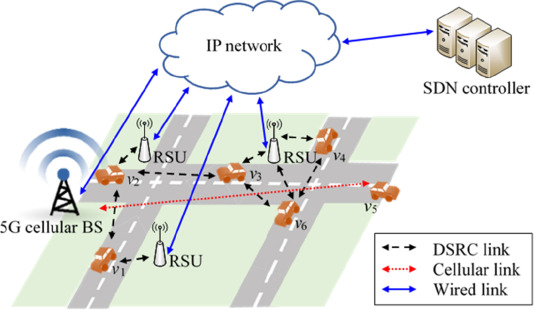
In an SDVN environment, controllers in the control plane manage different components such as eNodeB, roadside units (RSUs), and vehicles. Communication between these components is supported by wireless technologies that allow high-speed data transmission.
Frequently Asked Questions:
1. What is a Software-Defined Vehicular Network (SDVN)?
A Software-Defined Vehicular Network (SDVN) combines Software Defined Networking (SDN) with vehicular communication systems. It helps manage communication between vehicles, roadside units, and network infrastructure using a centralized controller.
2. Why is SDN used in vehicular networks?
Vehicles move quickly and often change their network connections. SDN helps manage these changes by providing centralized control and better network management, which improves communication efficiency.
3. What are some research topics in Software-Defined Vehicular Networks?
Some common research topics include controller placement strategies, blockchain-based vehicular networks, network security, control plane optimization, data offloading, resource management, and low-latency communication.
4. What are the benefits of Software-Defined Vehicular Networks?
SDVN helps improve network scalability, communication reliability, and data delivery. It also helps manage network resources more efficiently in fast-moving vehicular environments.
5. Why do researchers choose Kenfra Research for PhD assistance?
Many researchers choose Kenfra Research because they offer guidance throughout different stages of PhD research, including topic selection, proposal development, simulations, and research documentation. Their support helps scholars manage their research work more effectively.
Research Support
Researchers working in this area may require support in proposal development, simulation, research paper preparation, or thesis writing. With proper guidance and technical expertise, research in Software-Defined Vehicular Networks can be developed further to address real-world transportation challenges. Kenfra Research provides guidance and support for scholars working in this domain. Known for offering PhD research assistance in India, the team helps researchers with proposal development, simulations, and research documentation throughout different stages of their PhD work.







Leave a Reply