

The CRM Mistake 90% of Businesses Still Make in 2025
Kenfra Research - Bavithra2025-12-22T17:42:40+05:30In 2025, customer relationship management systems are used by almost every business. From small startups to large organizations, CRM tools are considered essential. Yet, even after years of experience and improvements, one CRM mistakes continue to affect nearly 90% of businesses. This mistake is not about choosing the wrong CRM software. It is about how businesses misuse, misunderstand, and poorly manage CRM in their daily operations. As a result, CRM becomes a burden instead of a solution.
Top CRM Mistakes Businesses Still Make in 2025
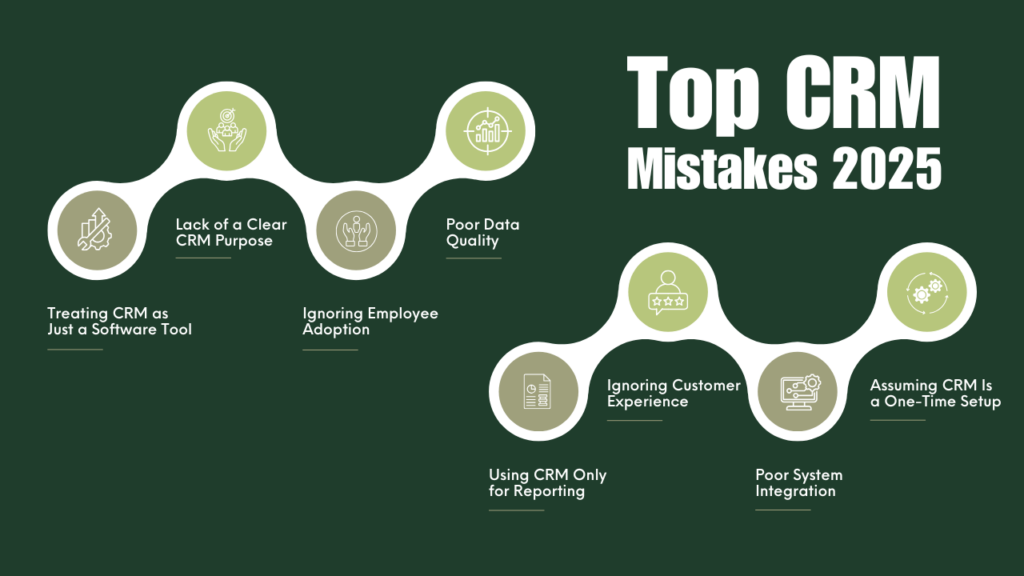
1. Treating CRM as Just a Software Tool
The most common CRM mistakes in 2025 is viewing CRM as nothing more than a software application. Many businesses believe that simply installing a CRM system will automatically improve customer relationships.
In reality, CRM is designed to support people and processes, not replace them. When CRM is treated as a purely technical tool, employees either use it mechanically or avoid it altogether. This leads to incomplete data, missed opportunities, and inconsistent customer experiences.
2. Lack of a Clear CRM Purpose
Another major mistake is implementing CRM without clearly defining its purpose. Some teams use CRM for sales tracking, others for marketing, and some only for reporting.
Without a shared objective, CRM usage becomes inconsistent. Teams interpret the system differently, creating data gaps and confusion. Over time, CRM loses credibility and becomes underutilized.
3. Ignoring Employee Adoption
Many businesses in 2025 still overlook how employees experience CRM. When users see CRM as extra work instead of a helpful tool, adoption suffers.
Poor training, complex interfaces, and unnecessary data entry make CRM frustrating. When records are not updated regularly, the system quickly becomes outdated. The problem is often blamed on the software, while the real issue is low user engagement.
4. Poor Data Quality
One of the most damaging CRM mistakes is neglecting data quality. In many organizations, customer records are incomplete, duplicated, or outdated.
When data cannot be trusted, employees stop relying on CRM. Sales forecasts become inaccurate, marketing campaigns underperform, and customer support struggles to deliver consistent service.
5. Using CRM Only for Reporting
Many businesses treat CRM as a reporting tool rather than a daily working system. Employees update CRM only when reports are due, not as part of their regular workflow.
CRM should actively support daily operations—tracking interactions, guiding follow-ups, and improving customer engagement. When used only for reports, CRM becomes passive and fails to deliver real value.
6. Ignoring Customer Experience
Another common mistake is designing CRM processes for internal convenience instead of customer experience.
This results in robotic communication, delayed responses, and poor personalization. In 2025, customers expect businesses to remember their preferences and history. When CRM fails to support this expectation, customer satisfaction declines.
7. Poor System Integration
Many organizations still operate CRM in isolation. Without proper integration, customer data is spread across multiple platforms.
This causes duplicated work, errors, and slower response times. CRM should act as a central hub for customer information, but poor integration prevents it from fulfilling this role.
8. Assuming CRM Is a One-Time Setup
Another critical mistake is treating CRM implementation as a one-time project. Businesses often configure CRM once and never revisit it.
As processes evolve, CRM becomes outdated and misaligned with daily operations. Successful businesses continuously review, update, and improve how they use their CRM systems.
9. Blaming the CRM Instead of the Process
When CRM fails to deliver results, many businesses blame the software. In reality, CRM often exposes existing process weaknesses.
Unclear ownership, poor discipline, and broken workflows are reflected in the system. Ignoring these issues prevents real improvement and long-term success.
10. Lack of Leadership Involvement
Leadership disengagement is another major CRM mistake. When leaders do not actively use CRM, employees do not take it seriously.
CRM adoption improves significantly when leadership relies on it for decision-making. Without leadership involvement, CRM becomes optional rather than essential.
Frequently Asked Questions
1. What is the biggest CRM mistake businesses make in 2025?
The biggest CRM mistake is treating CRM as software instead of a system that supports people and processes.
2. Why do CRM systems fail even today?
CRM systems fail due to poor data quality, low employee usage, unclear purpose, and lack of leadership involvement.
3. Can changing CRM software fix these mistakes?
No, changing software does not fix CRM mistakes caused by poor strategy and usage habits.
4. How can businesses avoid CRM mistakes?
Businesses can avoid CRM mistakes by defining clear goals, involving employees, maintaining clean data, and reviewing CRM usage regularly.

Conclusion
The CRM mistake that 90% of businesses still make in 2025 is not related to technology but to behavior. Many businesses misuse CRM systems, ignore their real purpose, and fail to use them consistently. CRM is not just a place to store customer information; it is meant to build stronger and long-lasting customer relationships. Businesses that understand this and correct these mistakes will gain real value from their CRM, while others will continue to face challenges.
If you are facing issues with your existing CRM or searching for a reliable and effective solution, Kenfra CRM Portal offers one of the best CRM portals in India with a free trial. You can explore Kenfra Portal to manage customer relationships more efficiently and grow your business with confidence.








Leave a Reply