

The Hidden Role of Literature Surveys in High-Impact Publications
Kenfra Research - Bavithra2026-01-10T16:16:47+05:30Publishing in high-impact journals is not just about having a good idea or strong results. One of the most important but often underestimated factors is the literature survey in research. Many students and researchers often ask what is literature survey and why it is considered so important in academic work. A literature survey is not just a section added to a paper or thesis for formality. In reality, it plays a key role in shaping the quality, clarity, and impact of any research work, especially when targeting high-impact journals.
This blog explores the hidden role of literature survey in research, why it is critical for high-impact publications, and how researchers can improve it.
What Is a Literature Survey in Research?
A literature survey in research is, in fact, a detailed study of existing scholarly articles, books, conference papers, and reports related to a research topic. Its main purpose, therefore, is to understand what has already been done and, consequently, identify where new research is needed. Moreover, it provides insight into gaps in the literature, helping researchers pinpoint areas for further investigation. As a result, it serves as a foundation for future research. Lastly, it ensures that the study contributes meaningfully to the field.
Unlike a simple summary, a good literature survey:
- Analyzes previous studies
- Compares different approaches
- Identifies trends and gaps
- Builds a strong foundation for new research
In high-impact journals, reviewers expect the literature survey to show depth, clarity, and originality of thought.
Why High-Impact Journals Give Importance to Literature Surveys?
High-impact journals receive thousands of submissions every year. To filter quality research, editors focus heavily on the literature survey in research. Here’s why:
1. Shows Research Awareness
A strong literature survey, for instance, demonstrates that the researcher understands the field deeply. It highlights knowledge of important theories, recent studies, and key contributors. By showing awareness of what has already been done, it, in turn, reassures readers that the work is well-informed. This understanding, consequently, helps build a strong foundation for the research and effectively guides the study in the right direction.
2. Justifies the Research Gap
A literature survey clearly explains what is already known and what is still missing in the field. It helps show why the current study is necessary and how it adds new knowledge. Without identifying a research gap, the work may seem repetitive or unoriginal. A clear explanation of the gap strengthens the purpose and relevance of the research.
3. Improves Research Credibility
Citing relevant studies and evidence, for instance, makes the research more trustworthy. When claims are supported by existing scholarly work, reviewers and readers, consequently, have greater confidence in the study. This not only demonstrates that the research is not just based on opinion, but, rather, is grounded in verified knowledge. As a result, this added credibility is crucial for gaining recognition and ultimately achieving publication success.
The Hidden Role of Literature Survey as a Strategy Tool
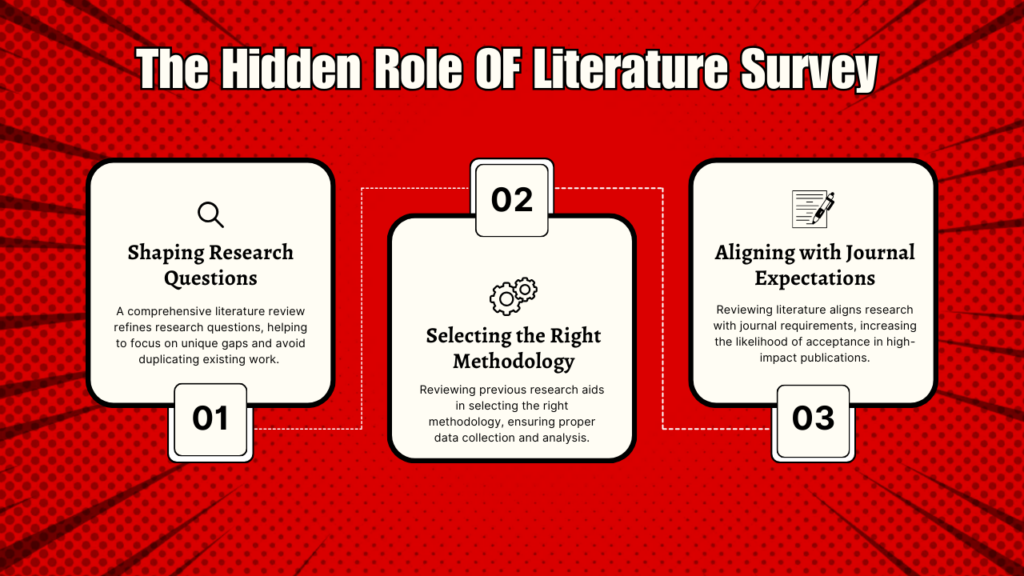
Many researchers see the literature review as a background section. However, in reality, it works as a strategic tool.
Shaping Research Questions
A thorough literature survey, for example, helps refine research questions and objectives. It ensures that the study focuses on meaningful problems while, at the same time, avoiding the repetition of work that has already been done. By understanding what has been explored, researchers can, therefore, identify existing gaps and design questions that, in turn, truly add value to the field.
Selecting the Right Methodology
Reviewing previous studies guides researchers in choosing appropriate research methods. It helps avoid common mistakes, improves data collection and analysis, and ensures the study is methodologically sound. Learning from earlier work increases the chances of producing reliable and high-quality results.
Aligning with Journal Expectations
Different journals, for instance, have specific themes, standards, and expectations. A well-organized literature survey, therefore, ensures that the research aligns with the scope and requirements of high-impact journals. As a result, this increases the likelihood that the paper will be accepted and, ultimately, recognized by the scientific community.
FAQs on Literature Survey in Research
1. What is the difference between literature review and literature survey?
Both terms are often used interchangeably. However, a literature survey usually focuses on mapping existing research, while a literature review includes deeper analysis and critique.
2. How long should a literature survey be?
There is no fixed length. It depends on the journal or thesis requirements, but it should be detailed enough to justify the research gap clearly.
3. Can a weak literature survey lead to rejection?
Yes. Many high-impact journals reject papers mainly due to poor literature surveys, even if the results are good.
4. Is a systematic literature review better for publications?
Yes, for some fields. A systematic literature review follows a structured method and is highly valued in reputed journals.

Conclusion
Understanding what is literature survey and applying it correctly can make a major difference in research quality and publication success. Whether it is a student project or a high-level research paper, the literature survey acts as the backbone of academic work. If you need any help with your literature survey, Kenfra Research will provide expert guidance and support to ensure it is clear, analytical, and well-structured, greatly improving your chances of publication success. A well-written literature survey improves clarity, strengthens arguments, and increases acceptance chances in reputed journals.








Leave a Reply