
Edge AI vs Cloud AI: Which One Is Better for IoT Applications?
Kenfra Research - Bavithra2025-12-30T17:19:36+05:30In recent years, artificial intelligence (AI) has become a game-changer for Internet of Things (IoT) applications. With more devices connecting to the internet, the need for faster and more efficient processing of data has led to the rise of two distinct approaches: Edge AI and Cloud AI. Both have their unique strengths, but understanding their differences is crucial in deciding which one works best for your IoT applications.
In this article, we’ll explain Edge AI vs Cloud AI, comparing them in terms of performance, speed, processing power, and more. This will help you figure out which one works best for your needs.
What Is Edge AI?
Edge AI is a type of AI where the data is processed directly on the device where it’s created, such as sensors or cameras. Instead of sending data to the cloud, the AI works “on the edge,” where it generates the data. The device processes the data directly, instead of the data being processed on the cloud.
Advantages of Edge AI:
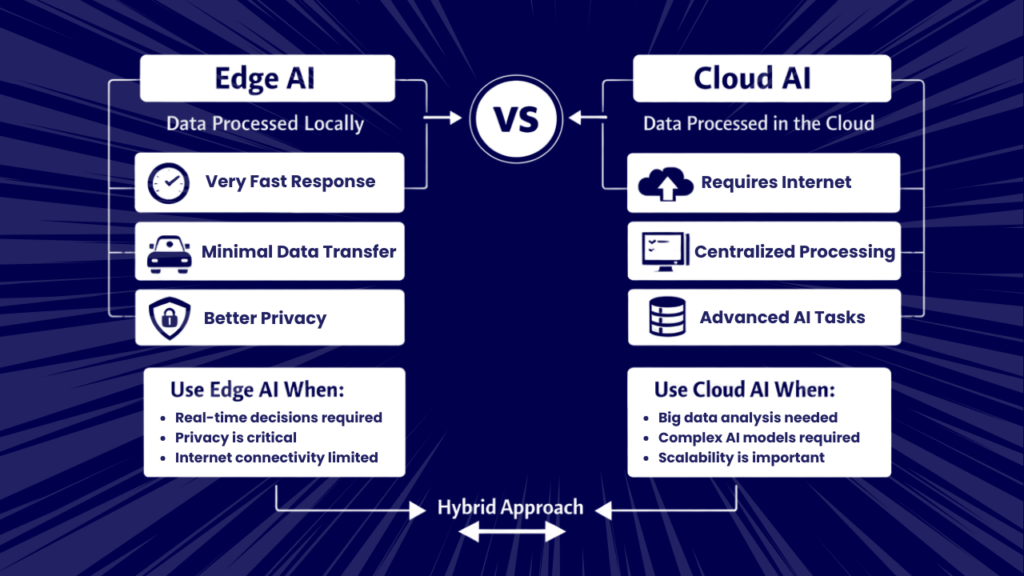
- Faster decisions: Since the AI processes data locally, it can react faster, which is important for real-time tasks like security or industrial automation.
- Less data sent over the internet: Edge devices don’t need to send lots of data to the cloud, saving bandwidth and avoiding network problems.
- Better privacy: Sensitive data stays on the device, making it more secure.
What Is Cloud AI?
Cloud AI means that the data from IoT devices send the data to the cloud for processing. In the cloud, powerful computers in the cloud process the data and return the results. Cloud AI can handle more complex tasks and larger amounts of data, but it requires an internet connection.
Advantages of Cloud AI:
- More power: The cloud has a lot of computing power, so it can process large amounts of data and run advanced AI models.
- Centralized processing: All data is stored in one place, which makes it easier to manage and analyze.
- Easy to update: Cloud AI can be updated easily, allowing for quicker improvements and new models.
Key Differences Between Edge AI vs. Cloud AI
Choosing between Edge AI and Cloud AI depends on what your IoT application needs. Some systems need fast responses and strong privacy, while others need high processing power and large data analysis. Below are simple use cases for both.
When to Use Edge AI?
Edge AI is best when decisions must be made quickly and data should stay on the device. It works without depending heavily on the internet.
1. Autonomous Vehicles:
Vehicles need instant decisions to avoid accidents. Edge AI processes data in real time.
2. Smart Homes:
Devices like smart cameras, lights, and thermostats work faster and protect user privacy by processing data locally.
3. Wearables:
Fitness bands and smartwatches analyze health data on the device to give immediate feedback.
When to Use Cloud AI?
Cloud AI is useful when large amounts of data need to be processed and stored in one place. It is ideal for advanced analysis and long-term insights.
1. Predictive Analytics:
Cloud AI studies large datasets from machines to predict faults and reduce downtime.
2. Healthcare Systems:
Medical data from many devices is processed centrally for diagnosis, monitoring, and research.
3. Big Data Applications:
When IoT devices generate huge volumes of data, Cloud AI handles storage and complex analysis efficiently.
FAQs: Edge AI vs Cloud AI
1. Which is better for real-time IoT applications Edge AI or Cloud AI?
Edge AI is better for real-time applications due to its lower latency and local processing, making it ideal for time-sensitive tasks.
2. Can Edge AI and Cloud AI be used together?
Yes, many IoT systems use a hybrid approach, with Edge AI handling real-time tasks and Cloud AI processing large-scale data and performing deeper analytics.
3. What are the benefits of Edge AI?
Edge AI offers fast processing, lower latency, enhanced privacy, and reduced reliance on bandwidth.
4. What are the main advantages of Cloud AI?
Cloud AI provides scalability, centralized processing, powerful computational resources, and easier model management.
5. How does Edge AI improve security?
Edge AI allows sensitive data to be processed locally, reducing the need to transmit it to the cloud and minimizing security risks.
Conclusion
Choosing between Edge AI vs Cloud AI depends on your specific use case and requirements. If your IoT application requires low latency, real-time decision-making, and enhanced privacy, Edge AI is your go-to solution. On the other hand, if you’re dealing with large datasets, need advanced machine learning capabilities, or require scalability, Cloud AI may be a better fit.
Kenfra Research understands the challenges faced by PhD scholars and offers tailored solutions to support your academic goals. From topic selection to advanced plagiarism checking.










Leave a Reply