20Dec
Facing rejection for your research topic is a common experience for many PhD scholars and postgraduate students. Whether you selected your idea from a research topic list, developed it from research topic ideas, or modeled it after research topic examples, rejection can feel frustrating. However, research topic rejection usually means refinement is needed, not that your idea lacks value. Understanding how to strengthen your work and rethink the selection of research topic can significantly improve your chances of approval. This article explains why rejection happens and how to turn your idea into an acceptable and strong study.
In most cases, rejection happens because the idea is not presented clearly. A research topic may look interesting but fail to show a clear problem, research gap, or contribution. Sometimes students rely heavily on generic research topic examples without adapting them to current research needs.
Another common issue is choosing a topic that is too broad. This often happens when students pick ideas from a general research topic list without narrowing the scope. Reviewers prefer focused studies that can be completed within a reasonable time frame.
In fields like education, rejection often occurs when the research topic in education does not connect theory with practice. For example, an action research topic must clearly show how it solves a real classroom or institutional problem.
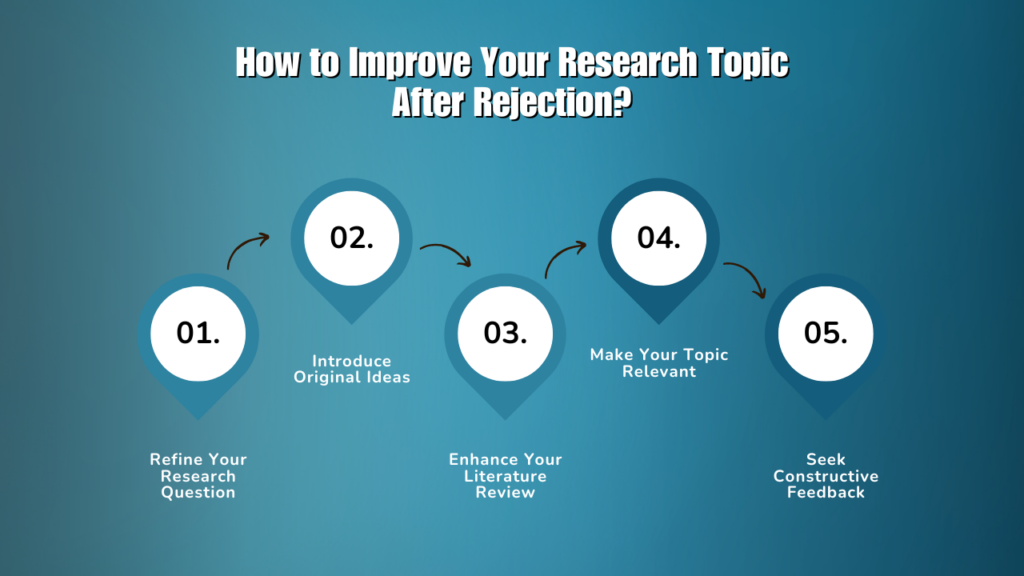
Once you understand the reasons for rejection, here’s how you can improve your research topic:
To avoid repeating the same mistakes, keep these things in mind:
Improving your research topic is about making it more focused, original, and practical. By paying attention to feedback and making thoughtful revisions, you’ll increase your chances of success. Remember, rejection isn’t the end—it’s just part of the process. With the right adjustments, you’ll be better prepared next time.
1. Why does a research topic get rejected even if it sounds good?
A topic may sound interesting but still lack clarity, originality, or feasibility. Clear objectives and a defined research gap are essential.
2. Can I reuse ideas from research topic examples?
Yes, but they must be adapted and updated. Directly copying ideas without adding value often leads to rejection.
3. Is action research accepted easily?
An action research topic is accepted when it clearly addresses a real problem and explains practical outcomes. Vague action plans often lead to rejection.
4. How do I know if my research topic is too broad?
If it covers multiple variables, regions, or objectives without focus, it is likely too broad. Narrowing the scope improves acceptance.
Research topic rejection is not the end of your academic journey. It is a learning step that helps refine your thinking and research skills. By understanding feedback, strengthening literature support, narrowing focus, and improving clarity, you can turn rejection into approval.
For scholars who need expert guidance, kenfra research offers all kinds of PhD support, including research topic selection, proposal development, literature review, methodology assistance, and complete doctoral guidance.
Delhi HC sets aside decision by JNU to rusticate and evict PhD scholar Jawaharlal Nehru University (JNU):Jawaharlal Nehru University (JNU) is... read more
AISHE 2021-22: Average enrolment of colleges going down in Odisha All India Survey on Higher Education (AISHE):The All India Survey on... read more
"Official: Students should adapt to changing times" seems to be a statement indicating that educational institutions or authorities believe that... read more
Best Databases for Academic Papers in 2024 read more
IISc Bangalore’s Advanced Certification Programme in Digital Manufacturing and Smart Factories is creating industry-ready experts to revolutionise Industry 4.0 The Indian... read more
Writing a PhD thesis is a monumental task that requires dedication, time management, and strategic planning. As daunting as... read more
PU to bridge industry-academia gap with ‘prof of practice’ post: Professor of Practice: It is a specialized position within academia that differs... read more
WhatsApp us
Leave a Reply