
From Data to Discovery: How PhD Research Is Transforming in the AI Era?
Kenfra Research - Bavithra2025-11-28T17:10:04+05:30AI in PhD research is no longer a future idea. It is already changing how scholars collect data, write papers, analyze results, and make scientific discoveries. Whether you are in engineering, social sciences, biology, management, or humanities, AI tools are becoming part of everyday research work. Instead of replacing the researcher, AI is helping PhD scholars work faster, think deeper, and produce more accurate results.
Today’s research world moves faster than ever. There is more data, more literature, and more pressure to publish. This is where AI becomes a powerful partner. With the right tools and skills, PhD students can turn hours of manual effort into minutes of productive work.
Why AI Matters in Modern PhD Research?
Today, almost every field from social sciences to biotechnology deals with massive amounts of data. Traditional methods make it hard to analyze such large datasets manually. This is where AI in academia becomes a powerful partner.
1. Faster Data Processing
AI tools can scan and analyze large volumes of information in seconds. Tasks that once took weeks, such as coding interview transcripts or scanning scientific papers, can now be done automatically. This allows scholars to spend more time on interpretation instead of manual labor.
2. Improved Accuracy
AI-driven analysis reduces human error. Whether you are testing a hypothesis, building a model, or cleaning data, modern tools make the results more reliable and repeatable.
3. Better Access to Information
With the help of AI search engines and smart libraries, students can locate relevant studies faster. These tools summarize long papers, highlight important findings, and even recommend related research topics.
How AI-Powered Tools Are Transforming Every Stage of PhD Research?
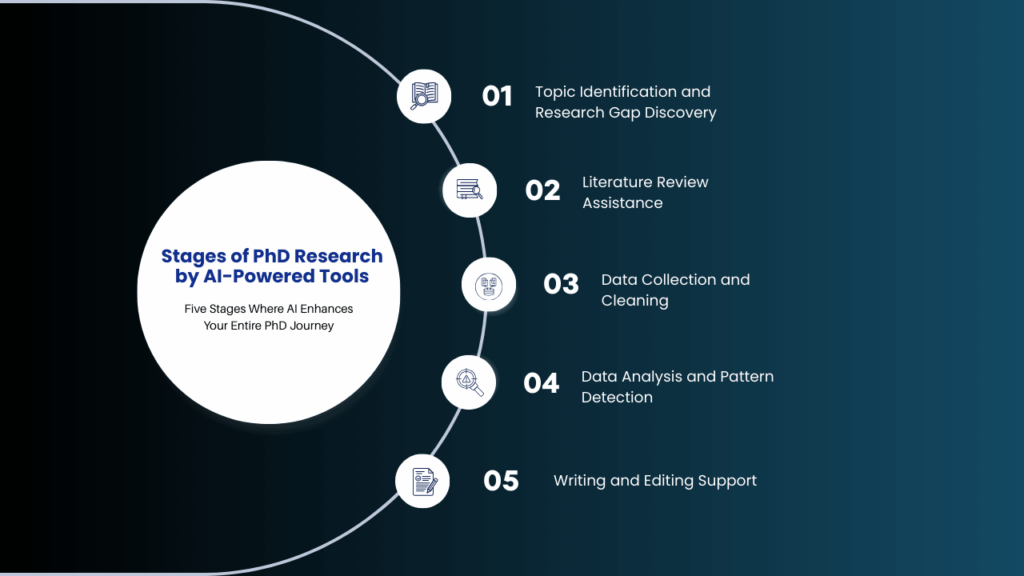
Different research stages now have AI-powered support. Here’s how modern scholars use them.
1. Topic Identification and Research Gap Discovery
Machine learning tools scan thousands of articles to help identify:
- research gaps
- trending topics
- potential problem statements
- unexplored areas
This makes the early stage of research much easier and more strategic.
2. Literature Review Assistance
Doing a literature review can be overwhelming. AI tools help by:
- summarizing long research papers
- highlighting authors, keywords, and citations
- grouping papers into themes
- detecting conflicting studies
This directly improves productivity and helps students complete their review faster.
3. Data Collection and Cleaning
Whether you collect survey responses, lab readings, images, or statistical data, AI tools can clean and prepare datasets automatically. This is especially helpful for large data projects in fields like psychology, engineering, or environmental studies.
4. Data Analysis and Pattern Detection
AI algorithms perform complex analysis such as:
- predictive modeling
- clustering
- text mining
- sentiment analysis
- data classification
These methods help researchers uncover patterns that humans may not see easily.
5. Writing and Editing Support
AI-powered editing tools help improve writing clarity, grammar, reference formatting, and consistency. They do not replace academic thinking, but they help refine the final output.
Real Examples of AI Transforming PhD Research
Example 1: Social Science Research
A PhD student studying public opinion can use AI to analyze thousands of social media posts or survey responses instantly. Tools can classify emotions, detect patterns, and even compare trends over time.
Example 2: Biological and Medical Research
AI models can process medical images, identify gene sequences, or predict disease trends. This helps researchers reach discoveries that were previously impossible within short timelines.
Example 3: Engineering and Robotics
Machine learning supports simulation, optimization, and predictive testing. PhD scholars can model complex systems and make decisions with higher accuracy.
Benefits of AI-Powered PhD Research
1. Saves Time – Repetitive tasks like data entry, transcription, and formatting are handled by AI tools.
2. Improves Precision – Errors are reduced, and results become more reliable.
3. Encourages Innovation – Researchers gain insights that may not be visible through manual methods.
4. Enhances Collaboration – Cloud-based AI tools allow scholars and supervisors to work together in real time.
5. Strengthens Decision-Making – Visual dashboards and models help researchers interpret data more clearly and confidently.
Challenges to Consider in AI-Enhanced Research
Although beneficial, there are a few things researchers must keep in mind:
1. Ethical Concerns
AI must be used responsibly, especially when dealing with human data. Privacy and consent remain essential.
2. Technical Knowledge Requirements
AI tools may require basic understanding of data science or programming. While many tools are user-friendly, some still need training.
3. Risk of Overreliance
Relying too heavily on AI may limit critical thinking. Researchers must remain in control and verify AI results carefully.
4. Ensuring Academic Integrity
PhD students need to use AI tools ethically and follow university guidelines to avoid issues related to plagiarism or misuse.
How PhD Students Can Use AI Effectively?
1. Start with Small Tools
Begin with simple tools like:
- note-organizing apps
- AI summarizers
- reference managers
- plagiarism checkers
2. Learn Basic Data Skills
A little knowledge of Python, R, or machine learning can make research more powerful.
3. Work Closely with Supervisors
Discuss what AI tools are allowed and how to use them ethically.
4. Use AI for Support, Not for Complete Dependence
AI should help you enhance your research, not replace your original thinking.
Future of AI-Powered PhD Research
The academic world is moving towards deeper AI integration. Soon we will see:
- automated research assistants
- AI-generated experiment designs
- smart labs
- voice-controlled analytical tools
- real-time data interpretation
PhD research will become more efficient, collaborative, and data-rich. Scholars will spend less time on repetitive work and more time on discovery and innovation.

Frequently Asked Questions:
1. Is it acceptable to use AI tools for PhD research?
Yes. AI tools are widely accepted for tasks such as data analysis, literature review support, and editing—provided they are used ethically and responsibly.
2. Can AI replace traditional research methods?
No. AI supports research by making tasks faster and easier, but human judgment, creativity, and interpretation remain essential.
3. Do I need coding skills to use AI in research?
Not always. Many modern tools are user-friendly. However, basic coding knowledge can be helpful for advanced analysis.
4. Which fields benefit the most from AI-powered research?
Nearly all fields including social sciences, healthcare, engineering, business, environmental studies, and humanities benefit from AI tools.
5. Can AI help with writing my thesis?
AI can help refine structure, grammar, and clarity, but the content and intellectual contribution must come from the researcher.
Conclusion
The shift from data to discovery has never been faster or more accessible. AI-powered PhD research is transforming how scholars study, analyze, and publish. By using AI wisely, students can reduce workload, improve accuracy, and make more meaningful contributions to their field. The future of research belongs to those who embrace both technology and critical thinking.
At Kenfra Research, we provide complete PhD support in India from topic selection to data analysis, writing, and publication assistance. Reach out to us for expert help at every stage of your research journey.







Leave a Reply