

Is Your Journal ABDC Listed? Check Before You Publish
Kenfra Research - Bavithra2026-01-02T17:26:32+05:30Publishing in the right journal is one of the most important steps in an academic career. Before submitting your research paper, one question you must ask is: Is your journal among ABDC listed journals? Many researchers ignore this step and later face rejection, low academic value, or problems during PhD evaluation and faculty promotions.
The ABDC listed journals are widely accepted in business, management, economics, and related fields. Publishing in these journals improves your research credibility and academic recognition. This blog will help you understand what ABDC is, why it matters, and how to check whether a journal is ABDC listed before you publish.
What Is the ABDC Journal List?
The ABDC journal list is released by the Australian Business Deans Council (ABDC), an organization that represents leading business schools across Australia. This list evaluates and ranks academic journals in business, management, economics, finance, and related disciplines.
The ABDC journal list is updated periodically and is widely used by universities, PhD committees, and research institutions around the world to measure the quality and credibility of research publications.
If your paper is published in a journal included in the ABDC journal list, it means that your research meets global academic standards, your work has gone through a strict peer-review process and Your publication carries higher academic and institutional value.
Publishing in journals from the ABDC journal list strengthens your academic profile and improves acceptance during PhD evaluation, promotions, and research assessments.
How to Check if a Journal is ABDC Listed? A Step-by-Step Guide to ABDC Listed Journals
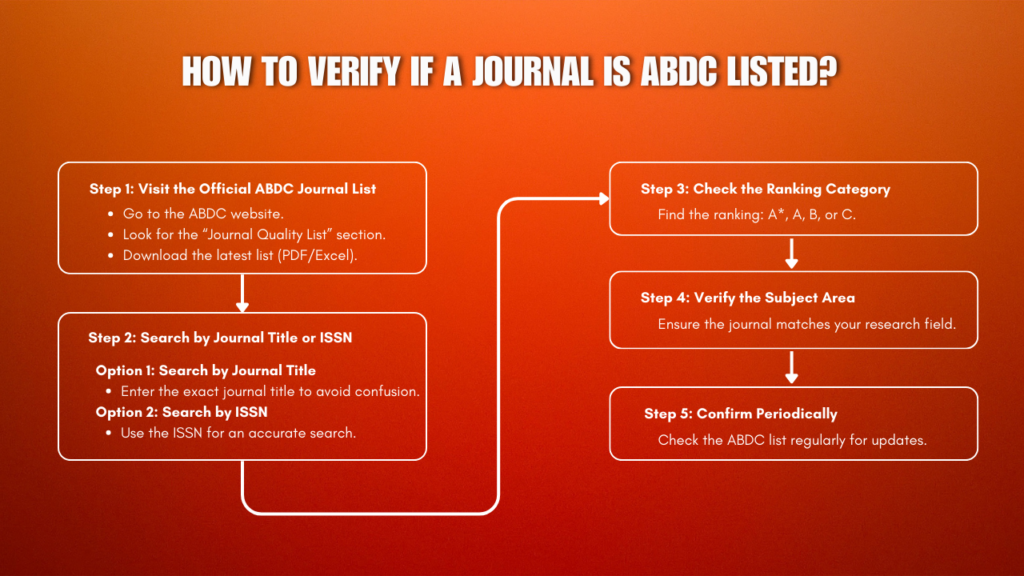
Step 1: Visit the Official ABDC Journal List
The first step is to access the official ABDC journal list. This list is updated regularly, so make sure you are consulting the most current version. You can find the ABDC journal list on the official website of the Australian Business Deans Council. Make sure to check the most up-to-date ABDC journal list before submitting, as it’s updated periodically, usually once a year. The website typically includes links to both the full list of journals and a searchable database.
How to find the list:
- Go to the official ABDC website.
- Look for the “Journal Quality List” section or a similar heading.
- You will usually have the option to download the list in formats such as PDF or Excel for offline browsing.
Tip: You can also find this list on university websites and academic research databases, as many institutions make the ABDC journal list available for their students and faculty.
Step 2: Search by Journal Title or ISSN
Once you have access to the list, you can search for the specific journal you are interested in. You have two primary ways to do this:
Option 1: Search by Journal Title
- Search for the exact title of the journal you are checking. Journal names can sometimes be quite similar, so be sure to type it correctly. Make sure to match the title exactly as listed in the ABDC database to avoid any confusion with similarly named journals.
Option 2: Search by ISSN
- If the title is ambiguous or common, it’s better to search using the ISSN (International Standard Serial Number). This is a unique identifier for journals and can help pinpoint the exact publication you’re interested in. The ISSN is usually found on the journal’s website or in the publication’s first page.
Step 3: Check the Ranking Category
Once you have found the journal in the list, the next thing to verify is its ranking category. The ABDC list classifies journals into four main categories based on their academic reputation and impact in the field. These categories are:
- A (A Star)* – These are the top-tier journals, recognized internationally for their high impact and scholarly contributions. Journals in this category are considered the most prestigious in their field.
- A – Journals in this category are also highly regarded and publish cutting-edge research, but their impact may not be as broad as the A* journals.
- B – Journals ranked as B are reputable but may focus on more specialized or niche areas within a field. They still maintain a good level of academic quality.
- C – Journals in this category are considered acceptable but may have a narrower audience or focus. They still publish peer-reviewed content, but their reputation may not be as strong as A or B journals.
Why this matters: The ranking determines the journal’s prestige and can affect how your paper is perceived in the academic community. Higher-ranked journals typically have more rigorous peer-review processes and a wider readership.
Step 4: Verify the Subject Area
ABDC categorizes journals not only by their ranking but also by the subject area or research domain they cover. It’s crucial to make sure the journal you’re interested in aligns with your field of research.
Common Subject Areas in ABDC:
- Management
- Finance
- Marketing
- Economics
- Operations and Supply Chain Management
- Accounting
Why this is important: Submitting to a journal outside your area of research could lead to unnecessary rejections, and may also not contribute to the academic community in the way you intend. Ensure that the journal is relevant to your discipline or area of study.
Additional Tips for Journal Selection:
- Look for Impact Factor (if available): Although ABDC does not rank all journals by impact factor, it’s always a good idea to cross-check the journal’s Impact Factor (if available) to assess its academic influence.
- Review Journal Scope and Aims: Visit the journal’s official website to read its scope and aims, which will tell you more about what type of research the journal is interested in.
- Read Submission Guidelines: Each journal will have submission guidelines outlining what they look for in submissions, including formatting, length, and the types of articles they accept. Following these is crucial to avoid rejection.
- Ask Advisors or Mentors: If you’re unsure about a journal’s credibility or fit, ask your academic advisor or mentors in your field. They may have experience with the journal or can recommend reputable ones.
Step 5: Confirm the Journal’s ABDC Status Periodically
Since ABDC updates its journal list from time to time, it’s essential to confirm the journal’s status regularly, especially if you’re planning to submit your paper over an extended period. A journal’s ranking can change as it grows in influence or as its editorial standards evolve.
How to stay updated:
- Check for updates on the ABDC website periodically.
- Set alerts or notifications through academic databases like Google Scholar or Scopus to track the journal’s ranking or publication frequency.
- Consult your institution’s library or research office to get the latest updates about any specific journal rankings.
FAQs about ABDC-Listed Journals
1. What is the difference between A*, A, B, and C rankings in ABDC journals?
The A* and A rankings represent top-tier journals with significant academic impact. B and C are lower-ranked journals, but they are still recognized within the academic community for publishing valuable research.
2. Can I submit my paper to any ABDC-listed journal?
While you can submit your paper to any ABDC-listed journal, it is advisable to choose one that aligns with your research domain. Submitting to a specialized journal will increase your chances of acceptance.
3. Is the ABDC journal list updated regularly?
Yes, the ABDC journal list is updated regularly to reflect the latest rankings and subject areas. Always check for the most current version before submitting your paper.
4. Can I use the ABDC journal list for journals outside of Australia?
Yes, the ABDC journal list is recognized globally and includes journals from various countries, not just Australia. It is an internationally respected resource for assessing journal quality.

Conclusion
Being aware of whether a journal is ABDC-listed is crucial for any academic researcher or PhD candidate. It ensures that your paper is published in a credible and globally recognized platform, which can positively influence your academic career. If you need assistance in selecting the right journal or preparing your paper for submission, Kenfra Research is here to help. We specialize in providing comprehensive PhD support and ensuring your research meets the highest academic standards. Reach out to us for guidance in navigating the world of academic publishing.






Leave a Reply