
Sales vs. Customer Success CRM: Tailoring Tools for Intent‑Driven Outcomes
Kenfra Research - Bavithra2026-02-17T10:09:40+05:30Many businesses invest in CRM software. But not everyone understands that there are different types of CRM tools. Some are built for closing deals. Some are built for keeping customers happy. If you use the wrong one for the wrong job, you lose time and money. In this blog, we’ll explain the difference between Sales CRM vs Customer Success CRM in simple words. No complex terms. Just clear information you can use.
What is a Sales CRM?
A Sales CRM is a tool designed to help sales teams manage leads, track deals, and close more business. It focuses on the sales pipeline and revenue growth. A Sales CRM mainly helps with:
- Managing leads and prospects
- Tracking sales activities like calls and emails
- Monitoring deal stages in the pipeline
- Forecasting revenue
- Automating follow-ups
The main goal of a sales management CRM is simple: move leads from “interested” to “closed won.” It helps sales reps know who to contact, when to follow up, and what action to take next.
If your company focuses on getting more customers and increasing conversions, then a Sales CRM software is essential.
What is a Customer Success CRM?
A Customer Success CRM is built for managing relationships after the sale is closed. Its goal is customer retention, satisfaction, and long-term growth. This type of CRM focuses on:
- Customer onboarding
- Tracking product usage
- Monitoring health scores
- Managing renewals
- Preventing churn
A customer success management software helps teams understand if customers are happy or at risk. Instead of focusing on closing deals, it focuses on keeping customers engaged and renewing their subscriptions.
If your business depends on recurring revenue, then a Customer Success CRM platform is very important.
Similarities Between Sales CRM vs Customer Success CRM
Sales and Customer Success may focus on different stages of the customer journey, but they share many core principles. Both teams work toward business growth and long-term customer value. Below are the key similarities explained in simple words.
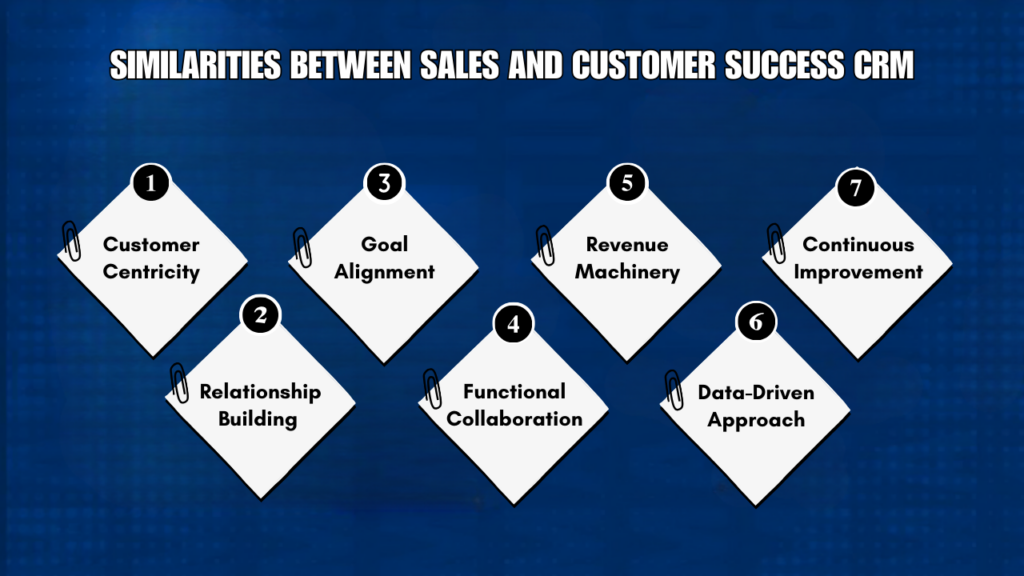
1. Customer-Centricity
Both Sales and Customer Success are built around the customer. Their main goal is to understand customer needs and provide the right solution. Sales teams listen to customer problems before offering a product or service. Customer Success teams continue that support after the deal is closed.
In both roles, success depends on putting the customer first. If the customer does not see value, neither team can succeed. Being customer-focused helps build trust, improve satisfaction, and increase loyalty over time.
2. Relationship Building and Stakeholder Management
Both teams focus heavily on building strong relationships. Sales builds trust during the buying process. Customer Success strengthens that trust after onboarding. They also manage multiple stakeholders within a company. This may include decision-makers, influencers, and daily users.
Clear communication and regular follow-ups are important in both roles. Strong relationships lead to repeat business and referrals. Without relationship management, both sales growth and retention become difficult.
3. Goal Alignment
Sales and Customer Success may have different daily tasks, but their larger goals are connected. Both aim to grow revenue and improve customer lifetime value. Sales focuses on acquiring new customers. Customer Success focuses on retaining and expanding those accounts.
If sales promises something unrealistic, customer success will struggle. If customer success does not deliver value, future sales may suffer. That is why both teams must stay aligned on expectations, messaging, and outcomes.
4. Cross-Functional Collaboration
Both teams work closely with other departments like marketing, product, and support. Sales provides feedback from prospects about market needs. Customer Success shares feedback from active customers about product performance.
This collaboration helps improve products, services, and overall customer experience. When teams communicate well across departments, businesses grow faster and serve customers better.
5. Revenue Machinery
Sales and Customer Success are both part of the company’s revenue engine. Sales generates new revenue through closed deals. Customer Success protects and expands revenue through renewals and upsells.
Without sales, there is no new business. Without customer success, there is high churn and unstable income. Together, they create a predictable and sustainable revenue model.
6. Data-Driven Approach
Both teams rely on data to measure performance and improve results. Sales tracks metrics like conversion rates, pipeline value, and win rates. Customer Success tracks churn rate, renewal rate, and engagement levels. Data helps both teams identify risks and opportunities early. A data-driven approach leads to smarter decisions and better outcomes.
7. Continuous Improvement
Sales and Customer Success both require constant learning and improvement. Sales teams refine their pitch, objection handling, and closing strategies. Customer Success teams improve onboarding, communication, and retention plans. Customer needs and market conditions change over time. Both teams must adapt to stay competitive. Continuous improvement ensures long-term growth and stronger customer relationships.
Sales CRM vs Customer Success CRM: The Core Difference
Here’s the simplest way to understand it:
Both are important. But they serve different parts of the customer journey.
Frequently Asked Questions
1. What is the main difference between a Sales CRM and a Customer Success CRM?
A Sales CRM focuses on managing leads and closing new deals. It helps sales teams track opportunities, follow up with prospects, and increase revenue. A Customer Success CRM focuses on keeping existing customers happy. It helps teams manage onboarding, monitor engagement, and reduce churn. In simple words, sales CRM drives acquisition, while customer success CRM drives retention.
2. Which CRM is better for a small business?
It depends on your main goal. If you are trying to grow and get more customers, a Sales CRM software is more important. If your business depends on recurring revenue or subscriptions, then a Customer Success CRM platform can be more valuable. Many small businesses start with a CRM system for sales and later add customer success features as they grow.
3. Can one CRM handle both sales and customer success?
Yes, some CRM systems offer features for both teams. This works well for small and mid-sized businesses. However, as your company grows, you may need more advanced tools. Sales teams may need strong pipeline tracking, while customer success teams may need health scores and renewal management. If your processes are complex, using separate tools for sales pipeline management and customer success management software may work better.
4. Do I need a Customer Success CRM if I already have a Sales CRM?
If your focus is only on closing deals, a Sales CRM may be enough at first. But if you want to reduce churn, improve onboarding, and increase customer lifetime value, then a customer retention CRM becomes important. Sales brings customers in. Customer success keeps them long term.

Final Thoughts
Understanding the difference between a Sales CRM vs Customer Success CRM is key to business growth.
A Sales CRM helps you acquire customers and increase revenue.
A Customer Success CRM helps you retain customers and increase lifetime value.
Both tools support different parts of the customer journey. One drives acquisition. The other drives retention and expansion.
If your goal is long-term growth, you may need both. By choosing the best CRM in India that fits your business model — whether it is a sales-focused solution or a customer success platform like Kenfra CRM — you can align your teams effectively.




Leave a Reply