

The Secret Sources for Identifying a Research Problem
Kenfra Research - Bavithra2026-03-14T16:29:03+05:30Finding a good research problem is one of the most important steps in the research process. Many students struggle with this stage because they think research topics must be completely new or complicated. In reality, most strong research ideas come from simple observations, everyday problems, and existing studies.
A clear research problem helps guide your entire project. It shapes your research questions, determines your research methodology, and defines the purpose of your study. Without a clear problem, research can become confusing and unfocused.
In this blog, we will explore some secret sources for identifying a research problem that researchers, students, and scholars often use.
Key Sources for Identifying a Research Problem
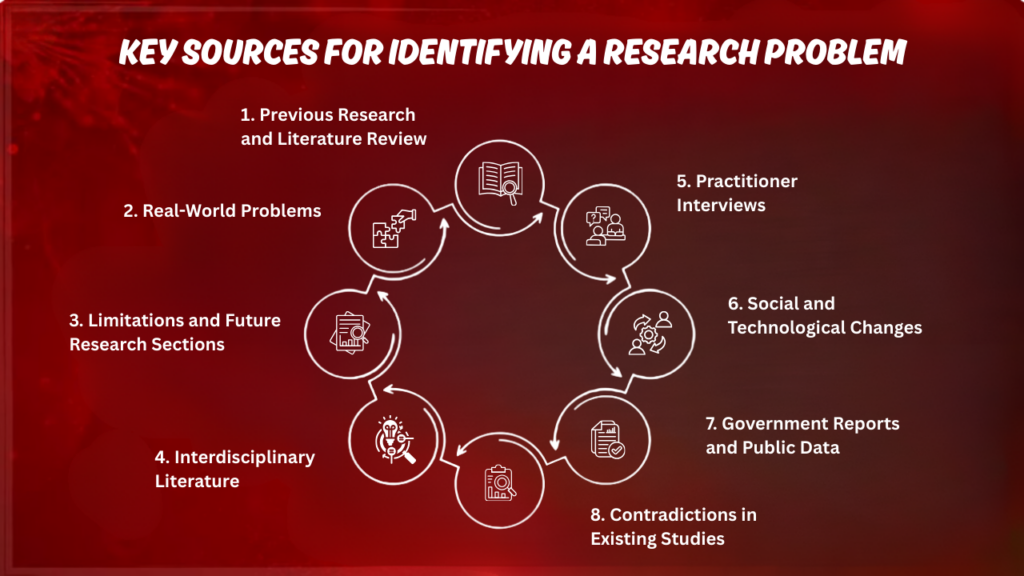
1. Previous Research and Literature Review
One of the most reliable sources for identifying a research problem is existing research. Reading academic articles, journals, books, and conference papers can help you understand what has already been studied and what still needs attention.
When researchers publish papers, they often mention research gaps or limitations in their work. These gaps are perfect opportunities for new research.
For example, a study may say that their research focused only on a small group of participants or a specific location. This suggests that future research could test the same idea in a different population or environment.
A careful literature review helps you:
- Understand current knowledge
- Identify unanswered questions
- Discover areas that need deeper investigation
2. Real-World Problems
Many research ideas come directly from real-life situations. Social issues, environmental challenges, technological changes, and health concerns often create opportunities for research.
For instance, increasing use of smartphones among students may raise questions about screen time and academic performance. Similarly, climate change raises many environmental research topics related to sustainability and public awareness.
Observing real-world problems can help researchers create studies that are meaningful and useful for society.
Examples of real-world research problems include:
- Mental health issues among college students
- Online learning effectiveness
- Waste management in urban areas
- Social media influence on youth behavior
Research that addresses practical problems often has a stronger impact because it can provide solutions.
3. Limitations and Future Research Sections
One of the most useful but often ignored places to find a research problem is the “Limitations” and “Future Research” sections of academic papers. These sections usually appear at the end of research articles.
Researchers explain the boundaries of their study, such as limited data, small sample size, or restricted location. They also suggest areas that future researchers should explore.
For example, a study about online learning effectiveness may only focus on students from one university. In the future research section, the authors might suggest studying students from different countries or education systems.
These suggestions are valuable because they directly highlight research gaps. By reviewing these sections carefully, you can easily identify new research topics and build on previous studies.
4. Interdisciplinary Literature
Another powerful source for identifying a research problem is interdisciplinary literature. This means studying research from different academic fields and combining ideas.
Many modern problems cannot be solved using only one discipline. For example:
- Technology and education combine computer science and pedagogy
- Health communication combines medicine and media studies
- Environmental policy combines environmental science and political science
When ideas from two fields intersect, new research questions often appear. For example, the combination of artificial intelligence and healthcare has created many research opportunities related to medical diagnosis and patient care.
Reading research from other disciplines can help you see problems from a new perspective and develop innovative research ideas.
5. Practitioner Interviews
Talking with professionals working in a specific field can also help identify strong research problems. These individuals are often called practitioners, and they deal with real-world challenges every day.
For example:
- Teachers understand classroom challenges
- Doctors know common healthcare issues
- Business managers face organizational problems
- IT professionals deal with cybersecurity threats
By interviewing practitioners, researchers can learn about problems that may not appear in academic literature. These real-world insights can lead to practical research topics that are relevant to industry and society.
Practitioner interviews also help researchers understand the practical impact of research and ensure their studies address real needs.
6. Social and Technological Changes
Society and technology are constantly changing, and these changes create new research opportunities.
For example, the rise of artificial intelligence, remote work, and digital education has created many new research questions.
Some emerging research areas include:
- Impact of AI on employment
- Online learning effectiveness after the pandemic
- Cybersecurity challenges in digital banking
- Ethical issues in data privacy
Researchers who pay attention to technological trends can identify many interesting and relevant research problems.
7. Government Reports and Public Data
Government organizations and international institutions regularly publish reports on social, economic, and environmental issues. These reports often highlight major problems that require further study.
Examples include reports on:
- Public health
- Education quality
- Economic development
- Environmental protection
These documents can help researchers identify important societal problems that need deeper analysis.
Sources like national statistics, policy documents, and global organizations provide valuable data that can inspire policy-related research topics.
8. Contradictions in Existing Studies
Another hidden source of research problems is conflicting research results. Sometimes two studies reach different conclusions about the same topic.
When this happens, researchers can investigate further to understand why the results differ.
Possible reasons may include:
- Different research methods
- Different populations
- Changes over time
Studying these contradictions helps strengthen scientific knowledge and improve research accuracy.
Frequently Asked Questions
1. What is a research problem?
A research problem is the main issue or question that a study tries to answer. It explains what the researcher wants to investigate and why the topic is important. A clear research problem helps guide the whole research process.
2. Why is it important to identify a research problem?
Identifying a research problem is important because it gives direction to the study. It helps the researcher decide what to study, how to collect data, and what methods to use. Without a clear problem, research can become confusing and unfocused.
3. How can students choose the right research topic?
Students can choose the right research topic by reading academic articles, observing real-world problems, discussing ideas with teachers, and identifying gaps in existing research. Choosing a topic they are interested in also helps them stay motivated during the research.
4. How does reading previous studies help in research?
Reading previous studies helps you understand what has already been researched. It also shows what questions are still unanswered. This makes it easier to identify a new research problem and avoid repeating the same work.

Final Thoughts
Identifying a strong research problem is the foundation of successful research. While many people think research ideas must be completely original, most great ideas come from simple and practical sources. By exploring literature reviews, observing real-world problems, discussing ideas with experts, and paying attention to social and technological changes, researchers can discover valuable research topics.
If you need guidance during your research journey, Kenfra Research provides PhD assistance in Tamil Nadu, helping scholars with research topic selection, proposal writing, literature review, and other academic support throughout the research process.






Leave a Reply